War Gains Popular Support; Patents; and other matters.

Chaos Manor View, Wednesday, March 11, 2015

clip_image001

National-Security Worries Rise as a Test for 2016

By a stunning 62%-30%, Americans now support sending U.S. troops to fight Islamic State.

By

William A. Galston

March 10, 2015 7:11 p.m. ET

181 COMMENTS

Events overseas are upending long-settled expectations about the 2016 presidential campaign.

In the two years after Barack Obama’s re-election, both political parties assumed that the 2016 election would hinge almost exclusively on the economy. As unemployment gradually subsided as a public issue, other economic concerns—such as stagnant wages, low labor-force-participation rates and declining social mobility—came to the fore. Potential presidential candidates in both parties jostled for field position as champions of opportunity for the middle class.

These issues will still be pivotal next year. But the Islamic State militants’ rise, the Russian threat to the peace of Europe and the Iranian challenge to stability in the Middle East have sparked increasing public worries about America’s security. Defense and foreign policy will not be as dominant in 2016 as they were in 2004, but they will be far more important than in 2008 and 2012.

The accumulating evidence from high-quality public-opinion research is hard to ignore. A Quinnipiac University survey released March 4 found that terrorism now trails only the economy as a top public priority: 67% of the American people regard Islamic State, also known as ISIS or ISIL, as a “major threat” to U.S. security. The public is not satisfied with the Obama administration’s response to this threat. Only 39% approve of the president’s handling of terrorism (down from 52% a year ago), while 54% disapprove. When it comes to ISIS, the public’s view is even more negative, with only 35% approving.

These sentiments translate into support for much more assertive policies. The Quinnipiac survey found that by a stunning 62% to 30%, the American people now support sending U.S. ground forces to fight ISIS in Iraq and Syria. Those in favor include majorities of Democrats and independents as well as Republicans, women as well as men, and young adults as well as seniors. This result underscores a late-February CBS poll, which found 57% of Americans favoring the use of ground forces, up 18 percentage points since last September.

http://www.wsj.com/articles/bill-galston-national-security-worries-rise-as-a-test-for-2016-1426029096

ISIS has declared war on the United States, and for that matter on much of the civilized word including both Shiite and Sunni Muslim States; they are literally an enemy of all except the lands they control. I opposed going into Iraq: Saddam was a brutal tyrant and sons were worse, but they were no threat to the United States on a global scale. Mostly it was a territorial dispute in Arabia, and not our vital interest; and even if it were, once regime change was effected, we should have been done. Democracy in the Middle East is no American goal, and likely to lead to enmity.

ISIS – The Caliphate – is another matter. Just now a division of US troops with the aid of the Warthog force could abolish the Caliphate in a year. We build a base in Kurdish “Iraq”, where we would have an acceptable status of forces agreement. And we liberate Kurdish Iraq and turn it over to the Kurds; then we ask Baghdad if they want a status of forces agreement now. If they insist on their previous nonsense, we continue the war, but operate out of what in effect will be Kurdistan. The Caliphate must go; it would take about a year, and cost a lot less than the previous war. We might even make a profit.

clip_image001[1]

Knock-off Apple Watches go on sale in China  ft

Charles Clover in Beijing •

clip_image002©Tim Bradshaw

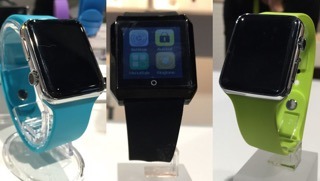
Fake Apple Watches — or at least watches that appear similar to the new devices and are suspiciously affordable — have gone on sale across China, as consumers jump the gun before the genuine items are available next month.

On ecommerce websites such as Alibaba’s Taobao, the watches appear nearly identical to Apple’s product, right down to the distinctive digital crown controller on the side of the device and four sensors on the underside.

Most do not have a brand marking, and cost Rmb250-Rmb500 ($40-$80) — about a tenth to one-fifth of the price of the cheapest Apple watch exhibited this week by Tim Cook, chief executive of the Cupertino-based group.

Revealed on Tuesday and scheduled to go on sale on April 24, Apple’s gold-cased luxury model costs up to $17,000 and appears to be aimed at wealthy Chinese buyers. In his multimedia presentation at the launch, Mr Cook highlighted that WeChat, China’s most popular chat app, could be used on the Apple device.

The early proliferation of fakes will not help Apple’s hopes of replicating the success of its iPhones in China, which is the world’s second-largest market for the smartphones behind the US.

Chinese knock-offs collectively demonstrate the speed, boldness and uncanny accuracy with which China’s counterfeiters can mimic even pioneering products.

Sellers have been fairly brazen about the provenance of their wares — on Taobao the “iwatch” was advertised with the slogan “Knockoff Apple watches have hit the market!”

But the seller cautioned: “If you are the kind of person who wants to compare a Rmb200 product with a Rmb3,000 Apple watch which has not been released, then this watch is not for you. Also, please stop asking us if this is the actual Apple watch.”

As early as January, Chinese companies were hawking knock-offs at the Las Vegas Consumer Electronics Show, costing as little as $27.

The Apple Watch fakes seen by the Financial Times at CES ran a version of Google’s Android operating system, redesigned to resemble Apple’s iOS.

Taobao is owned by Alibaba, the US-listed group that handles 70 per cent of China’s online commerce. The knock-offs were also seen on other ecommerce websites and have been on sale this week in shopping centres.

Chinese authorities have been cracking down on online counterfeiting. In January, the State Administration for Industry and Commerce (SAIC), a regulator, criticised Alibaba for allowing fakes on its websites. Alibaba said it was taking the matter seriously and was “dedicated to the fight against counterfeits”.

On Monday, Zhang Mao, head of the SAIC, said the regulator was seeking harsher punishments for merchants caught selling counterfeit goods, adding that ecommerce was growing at a faster pace than regulations and laws could cope with, and that companies and the government should co-operate.

Additional reporting by Ma Fangjing

The Financial Times
Little surprise here. Now it’s Apple’s move.

clip_image001[2]

Will equal-pay demands backfire on women? (MN)

By Karen D’Souza

kdsouza@mercurynews.com

POSTED:   03/10/2015 03:00:00 PM PDT

Actress Patricia Arquette called for equal pay from Hollywood to Main Street at the Oscars. Politician Hillary Clinton pushed for gender parity in high-tech, for smashing the glass ceiling that’s as much a part of the culture of Silicon Valley as apps and khakis.

Most reasonable people agree that women deserve a fair shake in the workplace, not to mention the halls of power, although it’s interesting how many pundits would prefer to nitpick at outspoken women like Arquette and Clinton rather than admit they touched a raw nerve.

The real trouble, however, is that no one knows how to get there from here.

Sheryl Sandberg reignited this age-old debate with her famous call for women to “lean in.” The Facebook CEO advocates that if women act more like men, if they are willing to work hard and negotiate harder, they can rise higher. Certainly there are examples of women who have followed this path to the top from the Valley to the Beltway.

Still the sad truth is that for many women, playing hardball can be disastrous advice in a volatile economy, where females still routinely make less than males. Think it can’t hurt to ask for a raise? Think again.

Recent studies show that women may actually be penalized for the same kinds of routine business negotiations that make men look like natural leaders — tough, tenacious and determined. Four studies conducted at Carnegie Mellon last year found that people dinged women who initiated negotiations for higher compensation more than they did men. This bias prevailed whether they watched videos of the negotiation or simply read about the scenario.

Most dire of all: Even women judged other women badly for trying to negotiate. Daring to ask for more money, in particular, was taboo.

http://www.mercurynews.com/entertainment/ci_27683110/will-equal-pay-demands-backfire-women

I recall that when I was growing up before WW II, “women’s liberation” meant that married women would not have to work outside the home. It was more about raising pay, but not for working women: it was about the right to stay home with the kids. But that was long ago. Still, a case can be made: children with a full time home stating parent are much advantaged over those raised by hirelings…

clip_image001[3]

Apple Dumpling Gang

A federal appeals court scoffs at the company’s antitrust bloodhound.

It’s not the new watch, but this week’s other big Apple news is that the Justice Department’s antitrust campaign is going about as well as the Russian winter did for Napoleon. On Tuesday the Second Circuit Court of Appeals heard oral arguments about the roving prosecutor embedded inside Apple, and the three judges seemed skeptical.

Apple is working to evict Michael Bromwich from its Cupertino offices, where the lawyer has camped since federal district Judge Denise Cote ruled that Apple conspired with publishers to fix digital book prices. The tech maker has a separate appeal on the antitrust merits before the Second Circuit, but this case is an important challenge to the racket of outside compliance monitors.

In all past civil litigation, special masters have been approved in settlements when companies consent to the terms of the oversight. They’re a tremendous gig for politically connected attorneys like Mr. Bromwich, and most companies that capitulate rather than fight probably deserve it.

But Mr. Bromwich was installed over Apple’s opposition, and he took the appointment as an invitation to all but bug the Apple boardroom. Mr. Bromwich’s investigation with an unlimited mandate and budget has drifted well afield of antitrust into Apple’s business and corporate culture.

Such treatment is usually reserved for institutions with a long history of criminality, like a state prison or corrupt union. They’re meant for Jimmy Hoffa, not the likes of Apple lead designer Jony Ive—who Mr. Bromwich demanded to interview, for some reason.

Apple argues that if judges appoint agents to act on their behalf, they must behave as disinterested and neutral officers of the court. Mr. Bromwich’s quasi-prosecutorial operation exceeds the judicial power and has included abuses such as collaborating ex parte with Justice to serve a witness against Apple in an adversarial hearing.

Judge Jesse Furman pressed DOJ’s lawyer Finnuala Tessier three times to concede that it would be “improper” if a judge had behaved like Mr. Bromwich. She ducked the questions, prompting him to joke about this discovery of new judicial powers—to laughter in the chambers.

Then there are the letters Mr. Bromwich sent directly to CEO Tim Cook and Apple directors in which he tried to circumvent attorney-client privilege and promote a relationship “that is unfiltered through outside counsel.” He later groused that Apple was “using its outside counsel as a shield to prevent interaction between senior management and my monitorship team.”

http://www.wsj.com/articles/apple-dumpling-gang-1426030373

There’s more, but you get the idea. It’s nice work if you can get it.

The panel was also astonished that Mr. Bromwich’s earnings and hourly billing rate remain under judicial seal. (He has charged Apple $2.65 million so far, as we reported in “All Along the Apple Watchtower.”) Judge Jacobs ordered Ms. Tessier to provide a declaration to the court on this point, which he said he may later release in the public interest. The compensation of an allegedly public official is not supposed to be a state secret.

The late Samuel Francis would call this a splendid example of anarcho-tyranny. I have no better term. The usual result of anarcho-tyranny is an attempt to restore reason and honor. Such coups are generally temporary if successful at all; it’s one of the paths a collapsing Republic can take.

clip_image001[4]

http://www.washingtonpost.com/blogs/innovations/wp/2015/03/11/heres-why-patents-are-innovations-worst-enemy/

Here’s why patents are innovation’s worst enemy (WP)

By Vivek Wadhwa March 11 at 8:00 AM

The Founding Fathers of the United States considered intellectual property so important that they gave it a special place in the Constitution: “To promote the progress of science and useful arts, by securing for limited times to authors and inventors the exclusive right to their respective writings and discoveries.”

The framers of the U.S. Constitution were not wrong. Patents did serve an important purpose during the days when technology advances happened over decades or centuries. In today’s era of exponentially advancing technologies, however, patents have become the greatest inhibitor to innovation and are holding the United States back. The only way of staying ahead is to out-innovate a competitor; speed to market and constant reinvention are critical. Patents do the reverse; they create disincentives to innovate and slow down innovators by allowing technology laggards and extortionists to sue them.

A new paper, Does Patent Licensing Mean Innovation, by Robin Feldman, of the University of California-Hastings Law School, and my colleague Mark Lemley, of Stanford Law School, dispels what doubt there may have been about the innovation value of patents. They analyzed the experience of real companies to see how often patent licenses actually spur innovation or technology transfer when patent holders assert their patents against companies. They found that almost no new innovation resulted. When patents were licensed, regardless of whether they were licensed from companies, patent trolls, or universities, they were practically worthless in enabling innovation.

The study underscores the need to broaden the focus of patent-reform efforts.

Instead of looking at licensing revenue and patent filings, as most academic research papers do, Feldman and Lemley did something unusual: they surveyed 188 technology-development companies in 11 different industry sectors, including computers and electronics, semiconductors, pharmaceuticals, medical devices, biotechnology, communications and energy. They asked detailed questions about patent licensing, lawsuits and how often patent licenses spur innovation or technology transfer. In other words, the value provided by technology that was licensed.

There’s more, and anyone interested in patent trollery is invited to read it.

clip_image001[5]

: Hm, The Daily Beast lunches on Clintonmail

Maybe all we have to do is ask the Chinese for copies of their captures of Clintonmail. Heck, maybe even Putin would provide copies. I wonder when Anonymous will post it all on WikiLeaks.

Hillary’s Secret Email Was a Cyberspy’s Dream Weapon http://www.thedailybeast.com/articles/2015/03/07/hillary-s-secret-email-was-a-cyberspy-s-dream-weapon.html?via=desktop&source=twitter

The Beast had a very nice lunch with left overs for an evening snack.

By the way, did anybody else notice her shifty eyes in her press conference? She looked at her notes, then the left wall, then her notes, then the right wall, then her notes, sometimes the back wall over audience heads, sometimes the ceiling; but, she never did look an audience member in the eye or the camera in its eye.

Combined with the clumsiness of the contrived comments this confirmed to me, “I am telling the biggest whopper of my life; but, I am a Clinton and you had best believe me lest you be Putinized.” (That last means “an enemy killed in a mysterious and suspicious manner such as Putin and the Clintons have apparently used in the past.)

{^_^}

I suspect we will hear more than we want to about Mrs. Clinton’s email in the year to come. There will be great argument about whether any laws were really broken. Maybe copies will be found on an unused desk in an ante-room at State, in late November, 2016.

clip_image001[6]

Department of War

Dr. Pournelle,
You wrote “[If there is] rot there you may be sure there is more in the field”
I submit the overworn observation that a fish rots from the head. I am retired enlisted and semi-retired engineer, in the latter capacity having more than 13 years of contract work for all the services and various similar or allied government agencies — call it 35 years of DOD experience altogether. In my personal experience I have become aware of multiple instances of flag officers lying – to the press, in congressional testimony, to their commands and/or to their superiors. Please note that I am excluding from judgment those cases of disinformation to the enemy, managerial manipulation, and social fibs that may be construed as duty or simple politeness.
IMO, Individuals at those ranks may still be able to serve with integrity, but I’ve come to view those cases as rare.
I resigned my last contract position (and left several others as quickly as could be arranged) rather than remain part of outright and ongoing acquisition fraud. A U.S. service chief of staff is on the congressional record (and YouTube) as stating that that particular system was the best and greatest ever. Becoming a whistleblower never appealed to me, and in most cases, reporting fraud waste and abuse is effectively prevented by the classified access clearance system.
I believe in bottom-up restructuring of DOD, and am cynical enough to think anything less is a half-measure.
Having had my rant, I must say that my experiences with the USMC have been markedly better than the rest. I have personally witnessed lone Marine Gunnies completing tasks with success and integrity — both of which qualities eluded well-staffed teams (engaged in very similar tasks) from the other services which were led by O-6 or higher. In my ideal scenario, the Marine Corps would lead the way (as usual) in rebuilding a department of war, and would become an independent service and not a financially neglected part of DON. I could easily be convinced to put the USN, USAF and Army under Marine Colonels, to start.
-d

There are persons of honor and competence in all the services; but the Iron Law can hold in military institutions as well as elsewhere, particularly if encouraged from civilian leaders.

clip_image004

Freedom is not free. Free men are not equal. Equal men are not free.

clip_image004[1]

clip_image006

clip_image004[2]

The mountains labor; the future of the dollar; Beware the fury of the Legions

Chaos Manor View, Tuesday, March 10, 2015

clip_image001

I was going for another story conference today, but John had problems, which is just as well because I still have a cold. Not bad, but it hangs on. Given that half the United States is suffering from Climate Change as Global Warming buries them under ten feet of snow, while Southern California is warm and sunny, I mustn’t complain.

The Apple Mountains labored, and have produced the Apple Watch. It may be a very profitable item, but for me it is not very interesting; at least not yet. I am reminded of one of Aesop’s fables: http://www.taleswithmorals.com/aesop-fable-the-mountains-in-labour.htm .

A watch that was in communication with my telephone, allowing me to dictate notes without removing the phone from its holster would be of more use to me; indeed a watch that was in integral part of the phone system might be very useful. The present ones seem to me more decorative, although their ability to keep my calendar without drawing out me phone is a good start.

clip_image001[1]

http://www.latimes.com/science/sciencenow/la-sci-sn-apple-medical-research-app-20150309-story.html

Apple’s medical research app raises hopes, questions (LA Times)

By MELISSA HEALY

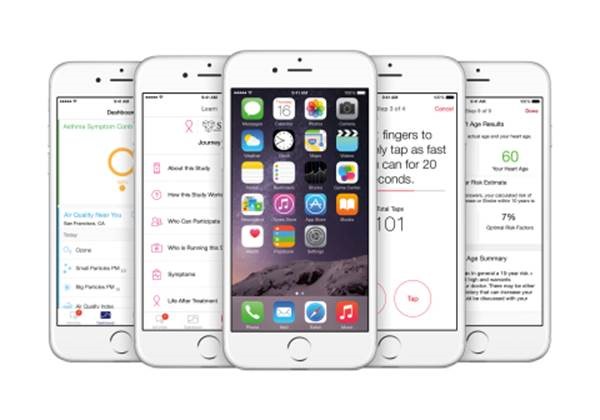
A new toolkit announced by Apple on Monday would allow medical researchers to tap into an expanding universe of iPhone users to recruit and enroll study participants, collect data and monitor health outcomes that are the object of research.

Apple on Monday made publicly available five new apps built by Apple and various university researchers using the toolkit. The company said it would release the open-access software for the toolkit next month, so other researchers could tailor apps to their needs.

Researchers studying asthma, Parkinson’s disease, diabetes, cardiovascular disease and breast cancer will be the first to use the new apps to conduct studies.

Most of the research being launched with the new applications appears to allow participants and researchers to track the daily lives and functioning of subjects and detect patterns that might lead to better disease-management practices.

One of the apps will be used as a part of an observational study that collects data from Parkinson’s patients in an effort to more fully understand the disease and how it affects daily life. Parkinson’s patients who download the app will be able to use the iPhone’s GPS and accelerometer to provide data on dexterity, balance, gait, voice strength and memory several times a day.

Apple Introduces ResearchKit, Giving Medical Researchers the Tools to Revolutionize Medical Studies

New Apps to Aid Research on Asthma, Breast Cancer, Cardiovascular Disease, Diabetes & Parkinson’s Disease

SAN FRANCISCO–(BUSINESS WIRE)– Apple® today announced ResearchKit™, an open source software framework designed for medical and health research, helping doctors and scientists gather data more frequently and more accurately from participants using iPhone® apps. World-class research institutions have already developed apps with ResearchKit for studies on asthma, breast cancer, cardiovascular disease, diabetes and Parkinson’s disease.* Users decide if they want to participate in a study and how their data is shared.

clip_image003

Apple introduces ResearchKit, giving medical researchers the tools to revolutionize medical studies. (Photo: Business Wire)

“iOS apps already help millions of customers track and improve their health. With hundreds of millions of iPhones in use around the world, we saw an opportunity for Apple to have an even greater impact by empowering people to participate in and contribute to medical research,” said Jeff Williams, Apple’s senior vice president of Operations. “ResearchKit gives the scientific community access to a diverse, global population and more ways to collect data than ever before.”

ResearchKit turns iPhone into a powerful tool for medical research. When granted permission by the user, apps can access data from the Health app such as weight, blood pressure, glucose levels and asthma inhaler use, which are measured by third-party devices and apps. HealthKit™ is a software framework Apple introduced with iOS 8 to provide developers the ability for health and fitness apps to communicate with each other. ResearchKit can also request from a user, access to the accelerometer, microphone, gyroscope and GPS sensors in iPhone to gain insight into a patient’s gait, motor impairment, fitness, speech and memory.

ResearchKit also makes it easier to recruit participants for large-scale studies, accessing a broad cross-section of the population—not just those within driving distance of an institution. Study participants can complete tasks or submit surveys right from the app, so researchers spend less time on paperwork and more time analyzing data. ResearchKit also enables researchers to present an interactive informed consent process. Users choose which studies to participate in and the data they want to provide in each study.

“We’re excited to use these new ResearchKit tools from Apple to expand participant recruitment and quickly gather even more data through the simple use of an iPhone app. The data it will provide takes us one step closer to developing more personalized care,” said Patricia Ganz, MD, professor at the UCLA Fielding School of Public Health and Director of Cancer Prevention & Control Research at UCLA’s Jonsson Comprehensive Cancer Center. “Access to more diverse patient-reported health data will help us learn more about long-term aftereffects of cancer treatments and provide us with a better understanding of the breast cancer patient experience.”

“When it comes to researching how we can better diagnose and prevent disease, numbers are everything. By using Apple’s new ResearchKit framework, we’re able to extend participation beyond our local community and capture significantly more data to help us understand how asthma works,” said Eric Schadt, PhD, the Jean C. and James W. Crystal Professor of Genomics at the Icahn School of Medicine at Mount Sinai, and Founding Director of the Icahn Institute for Genomics and Multiscale Biology. “Using iPhone’s advanced sensors, we’re able to better model an asthma patient’s condition to enable us to deliver a more personalized, more precise treatment.”

Developed by the Icahn School of Medicine at Mount Sinai and LifeMap Solutions, the Asthma Health app is designed to facilitate asthma patient education and self-monitoring, promote positive behavioral changes and reinforce adherence to treatment plans according to current asthma guidelines. The study tracks symptom patterns in an individual and potential triggers for these exacerbations so that researchers can learn new ways to personalize asthma treatment.

It took longer to bring this out than I would have thought, but it certainly is significant. Look for a new wave of such programs coupled with micro sensors of the sort I saw at the Hilton Island Nanotech Conference last year http://www.hh2014.org/general.html — there will undoubtedly be more this year http://www.mnmconferences.com/nanotechnologies_attend-conference.html?utm_source=Google&utm_medium=PPC&utm_campaign=Nanotech%20registration&gclid=CPjgw5TsnsQCFYqDfgodN2EAbw – and expect real progress. This might be incorporated into a watch. That would be progress indeed.

clip_image001[2]

The one Chinese innovation that could change the way we think about money (WP)

By Dominic Basulto March 10 at 8:59 AM

The new China International Payments System (CIPS), which is set to debut before the end of 2015, has been described as a “worldwide payments superhighway for the yuan.” What the creation of such a system means in the short-term is that the Chinese currency (officially known as the renminbi) has the potential to become a truly international, convertible currency and a more attractive currency for conducting international trade and finance. What it means in the long-term is that America’s long reign of economic dominance is at risk.

Ever since the end of World War II, the dollar has been the bedrock of the international financial system. The rise of a competitor currency to challenge the dollar seems almost impossible. While the euro and the yen have emerged as possible options for supplanting the dollar, they have never had the global clout of the U.S. dollar. China’s plans for the internationalization of the renminbi, though, are a different matter entirely. Given the size and heft of China’s economy, it only makes sense that China is creating a global payments system to make it easier for people to trade, invest and conduct transactions using the renminbi.

One way to measure how important the Chinese currency has become worldwide is to look at the percentage of international trade finance deals that are conducted using the renminbi. On a global basis, the renminbi accounts for nearly 9 percent of all trade finance deals worldwide, the second largest behind only the dollar. Moreover, as of January 2015, the renminbi is now the fifth most used payments currency in the world, trailing only the dollar, the euro, the pound sterling, and the yen. According to Wim Raymaekers, Head of Banking Markets at SWIFT, this is “an important milestone” that confirms the transition of the renminbi from an “emerging” to a “business as usual” payment currency.

One area where the launch of the new Chinese payments system could really have an impact is in the global energy markets. As a result of the so-called “petrodollar system” established between the U.S. and Middle East oil producers, oil exports are priced and transacted in dollars. Now imagine the price of oil being quoted in Chinese yuan and not U.S. dollars. What if Saudi oil exporters decide they want yuan and not dollars for their oil? That means anyone buying or selling oil in commodity markets has to have a yuan bank account in addition to a dollar bank account. Given the voracious energy demands of China’s growing economy, it’s easy to see why a global payments system facilitating these trades makes sense.

An interesting future. Farewell the Almighty Dollar and with it the Euro and the Ruble..

clip_image001[3]

: The Demise of Military Integrity

An apt article, if overdue.  I recall being told:  “there is the right way, the wrong way, and the army way”.

http://ow.ly/K921n

◊ ◊ ◊ ◊ ◊

Most Respectfully,

Joshua Jordan, KSC

Percussa Resurgo

Leaders lie “in the routine performance of their duties,” and “ethical and moral transgressions [occur] across all levels” of the organization. Leaders have also become “ethically numb,” using “justifications and rationalizations” to overcome any ethical doubts. This “tacit acceptance of dishonesty… [facilitates] hypocrisy” among leaders.

These quotations sound like they are ripped from the headlines about some major corporate scandal. But they’re not describing Enron before its collapse in 2001, or firms like Lehman Brothers and Countrywide before the 2008 financial crisis. Instead, they describe one of the country’s most respected institutions: the U.S. Army.

Leonard Wong and Stephen Gerras, who are both professors at the U.S. Army War College, just published a devastating study called Lying to Ourselves: Dishonesty in the Army Profession. They state up front that indications of ethical and moral problems can be found throughout the entire U.S. military, not just in the Army. These include (but certainly are not limited to) U.S. Air Force personnel cheating on tests about nuclear launch systems, and U.S. Navy admirals and others sharing classified information in exchange for gifts and bribes. Last year, Secretary of Defense Chuck Hagel appointed a two-star admiral as the first Senior Advisor for Military Professionalism to address mounting concerns about ethical issues throughout the force.

Nevertheless, this study of the Army deserves special attention, because its findings are so broad and deeply disturbing. Wong and Gerras find that it is “literally impossible” for Army officers to meet all the requirements imposed on them, but that it is also unacceptable for them to fail to meet the requirements. They routinely square this impossible circle by lying – about what they’ve done, who they’ve trained, and to what standard. Yet they maintain a self-image of integrity by rationalizing their lies in various ways. They no longer see this pervasive dishonesty as dishonorable, or even wrong. As Wong and Gerras argue:

“‘White’ lies and ‘innocent’ mistruths have become so commonplace in the U.S. Army that there is often no ethical angst, no deep soul-searching, and no righteous outrage when examples of routine dishonesty are encountered. Mutually agreed deception exists in the Army because many decisions to lie, cheat, or steal are simply no longer viewed as ethical choices.”

We have seen signs of this in the Academies; if there is rot there you may be sure there is more in the field. Of course there have always been Sergeant Bilko and his minions, and there have always been higher officers with political influence; is there more now? Recall the letter from Africa from the centurion.

We had been told, on leaving our native soil, that we were to defend the sacred rights conferred on us by so many of our citizens settled overseas, so many years of our presence, so many benefits brought by us to populations in need of our assistance and civilization. We were able to verify that this was true, and because it was true, we did not hesitate to shed our quota of blood, to sacrifice our youth and our hopes. We regretted nothing, but whereas we over here are inspired by their frame of mind, I am told that in Rome factions and conspiracies are rife, that treachery flourishes, and that many people in their uncertainty and confusion lend a ready ear to the dire temptations of relinquishment and vilify our action. I cannot believe that all this true, and yet recent wars have shown how pernicious such a state of mind could be and to where it could lead. Make haste to reassure me, I beg you, and tell me that our fellow citizens understand us, support us and protect us as we protect the glory of the Empire. If it should be otherwise, if we should leave our bleached bones on these desert sands in vain, then beware the fury of the legions.”

From a letter supposedly written by one Marcus Flavinius, a centurion in the second cohort of the 2nd Augusta Legion serving overseas, to his cousin, Tertullus, in Rome, quoted in the Prologue of Jean Larteguy’s novel, “The Centurions.” http://turcopolier.typepad.com/sic_semper_tyrannis/2009/09/the-angst-of-the-legions.html

(And yes, I am aware that this may be fiction; I first became aware of it as an epigraph in The Centurions; but fiction or not it expresses a real concern. But recall its results. Timocracies rarely last a generation. They are replaced by something far worse.)

clip_image001[4]

I am pleased to report a strong upsurge in sales of The California Sixth Grade Reader. http://www.amazon.com/California-Sixth-Grade-Reader-Pournelle-ebook/dp/B00LZ7PB7E/ref=sr_1_1?ie=UTF8&qid=1425595105&sr=8-1&keywords=california+sixth and I hope that will continue. Technology has given us some means of counteracting the abysmal plunge of the public education system. The Kahn Academy https://www.khanacademy.org/ is another. The Kahn site has recently been “improved” in a disturbing manner, but the underlying lessons seem as effective as ever.


clip_image001[5]

clip_image001[6]

clip_image005

Freedom is not free. Free men are not equal. Equal men are not free.

clip_image005[1]

clip_image007

clip_image005[2]

Abysmal Education, continued; Notes on AI; Warmest Year; Clinton eMails

Chaos Manor View, Thursday, March 05, 2015

clip_image001

While Steve Barnes was over for a story conference, we do talk about other things. One of them was his 11 year old son’s fascination with the California Sixth Grade Reader http://www.amazon.com/California-Sixth-Grade-Reader-Pournelle-ebook/dp/B00LZ7PB7E/ref=sr_1_1?ie=UTF8&qid=1425595105&sr=8-1&keywords=california+sixth+grade+reader available on Kindle.

His son very much liked the story of Jason and the Argonauts, but he is even more fascinated with the Macaulay poem Horatius at the Bridge. That’s no real surprise: just as girls are intrigued with the story of the romance in The Courtship of Miles Standish. Horatius has action, great lines, verses you can learn. Prior to this he was sort of reading at level in his school, meaning he had controlled vocabulary readers, and although he knew how to sound words out, he seldom had to do it because he seldom encountered new word and did care to read them if he did because the text wasn’t interesting. Horatius, on the other hand, is full of unfamiliar words, and he very much wants to know them because the poem is exciting. Not that this is anything that professors of education didn’t know in 1914, but they don’t know it now.

I was pleased to hear it because that is one of the reasons for getting the reader published. And I wasn’t surprised that he shows no similar interest in The Courtship of Miles Standish. Most boys don’t.

clip_image001[1]

The physical therapist was here with her ingenious tortures. Of course I feel better afterwards, but it makes for an interesting hour.

http://www.npr.org/blogs/alltechconsidered/2014/10/27/359302540/ive-got-the-ingredients-what-should-i-cook-ask-ibms-watson

I’ve Got The Ingredients. What Should I Cook? Ask IBM’s Watson (NPR)

OCTOBER 27, 2014 5:40 PM ET

LAURA SYDELL

IBM’s Watson computer has amused and surprised humans by winning at Jeopardy! Now, one of the world’s smartest machines is taking on chefs.

Well, not exactly. Watson is being used by chefs to come up with new and exciting recipes in a feat that could turn out to be useful for people with dietary restrictions and for managing food shortages.

If you give Watson a few ingredients and cuisine specifications, it can help you with recipe ideas. I had a few things in the kitchen, but I didn’t know what to make with them — ground turkey, frozen peas, dried mushrooms, canned tomatoes. I live in San Francisco, so it’s easy to get Asian and Mexican spices.

I sent an email to Watson and a couple of days later, the recipes arrived in my inbox. Watson sent three recipes for ground turkey and another for Mexican green pea pancakes. I picked one of the taco recipes and decided to make the pancakes.

The ingredients Watson chose were surprising. For example, the tacos called for grated citrus peel.

Though Watson can’t taste the recipes it churns out, it has an understanding of the chemistry behind taste. It understands what we humans enjoy and why, says Steven Abrams, an engineer with The Watson Group.

There is considerably more, but you get the idea.

The late L. Sprague de Camp was one of the funniest men ever to write science fiction, but he had no sense of humor; or at least as odd a sense of humor as anyone you will ever meet. He said he studied humor and jokes, and wrote what intellectually he thought would be funny. He did so successfully, as anyone who ever read The Incompleat Enchanter and his other fantasies knows full well. The point being that much of what is peculiarly human is intellectually understandable and describable; in theory a robot could do what Sprague did. Of course many of Sprague’s friends thought this was actually one of his jokes..

http://sploid.gizmodo.com/mind-control-breakthrough-quadriplegic-woman-flies-f-3-1689274525

Arati Prabhakar—director of the Pentagon’s advanced research arm DARPA—has revealed a breakthrough achievement in machine mind control. Jan Scheuermann, a 55-year-old quadriplegic woman with electrodes in her brain, has been able to fly an F-35 fighter jet using “nothing but her thoughts.”

= = =

Scheuermann—who is quadriplegic because of an hereditary genetic disease—was recruited by DARPA for its robotics programs. Scientists and doctors implanted electrodes in the left motor cortex of her brain in 2012 to allow her to control a robotic arm, which she did successfully. But she’s not using the robotic arms to control the joystick in the Lockheed Martin F-35 Lightning II simulator used for the tests. She is controlling the plane with “nothing but her thoughts,” according to Prabhakar, pure neural signaling:

Instead of thinking about controlling a joystick, which is what our ace pilots do when they’re driving this thing, Jan’s thinking about controlling the airplane directly. For someone who’s never flown—she’s not a pilot in real life—she’s flying that simulator directly from her neural signaling.

The implications of this for robotics are obvious.

clip_image001[2]

Coldest year on record

Hello Jerry,

I second your opinion that warm is preferable to cold.  Makes for a larger supply and better selection of food, too.

Re:  “It’s cold outside, even after the warmest year in history.”

The headlines worldwide and the lead story on EVERY news broadcast, as well as being the focus of the SOU message, was some iteration of ‘2014 was the warmest year since records began in 1880.’.  Of course it was all because of anthropogenic CO2 (ACO2) AND spelled doom if ACO2 were not drastically reduced or eliminated by the taxing and regulating of every human activity that produced a government-identified and quantified ‘carbon signature.

What wasn’t prominently featured in the stories is that the record was set by 0.02 degrees.

NONE of the stories expressed the slightest curiosity as to whether we have had a world wide data collection system in place since 1880 that allows the ‘annual temperatures of the earth’ to be placed in rank order by year OR whether the overall precision of the network over the 135 years was adequate to justify a ‘record’ anomaly of 0.02 degrees as statistically significant.

Of particular interest to me is that NO prominent climate scientist or group focusing on ‘climate change’ expressed ANY doubt as to the validity of the record OR its significance as a harbinger of ACO2 driven doom.

Bob Ludwick

To emphasize: the previous heat records were set in the 1930’s, and the “record” only starts in 1880 or so. We know that in 1880 most of the data were not accurate to a tenth of a degree, certainly not to a hundredth. Moreover, in the 30’s I cannot believe that data from the USSR, China, Chinese Turkestan, Russian Turkestan, much of Viet Nam, much of Indonesia, much of Africa were reliable at all and at times were not even available. The same would be true of parts – large parts – of South America. They had other worries to occupy their attention. China was largely under warlords, or Japanese occupation. I could continue but surely the point is made? We simply do not know the average temperature of the Earth to a tenth of a degree, now or in the 1930’s; the models assume warming, but actual data shows no warming for a decade.

clip_image001[3]

Clinton’s E-Mail System Built For Privacy Though Not Security – Bloomberg Business

(Bloomberg) — A week before becoming Secretary of State, Hillary Clinton set up a private e-mail system that gave her a high level of control over communications, including the ability to erase messages completely, according to security experts who have examined Internet records.

“You erase it and everything’s gone,” Matt Devost, a security expert who has had his own private e-mail for years. Commercial services like those from Google Inc. and Yahoo! Inc. retain copies even after users erase them from their in-box.

Although Clinton worked hard to secure the private system, her consultants appear to have set it up with a misconfigured encryption system, something that left it vulnerable to hacking, said Alex McGeorge, head of threat intelligence at Immunity Inc., a Miami Beach-based digital security firm.

The e-mail flap has political significance because Clinton is preparing to announce a bid for the Democratic nomination for president as soon as April. It also reminds voters of allegations of secrecy that surrounded Bill Clinton’s White House. In those years, First Lady Hillary Clinton fought efforts by some White House advisers to turn over information to Whitewater investigators and, later, sought to keep secret records of her task force on health-care reform.

Representative Trey Gowdy, a South Carolina Republican who leads a special committee looking into the events surrounding the 2012 terrorist attack at a U.S. diplomatic facility in Benghazi, Libya, said he will subpoena Clinton’s e-mails.

“We’re going to use every bit of legal recourse at our disposal,” Gowdy said Wednesday during an interview on CNN.

Private Service

The committee also said Wednesday that it has discovered two e-mail addresses used by Clinton while secretary of state.

Nick Merrill, a Clinton spokesman, didn’t immediately respond to a request for comment, though he said in a statement Tuesday that her practices followed “both the letter and spirit of the rules.”

Setting up a private e-mail service was once onerous and rare. Now, it’s relatively easy, said Devost, president of FusionX LLC, based in Arlington, Virginia.

I have mixed emotions here. I would rather have a private mailbox were I Secretary of State. But there are matters of security and public responsibility. But an official mailbox gets lots of Spam..

clip_image001[4]

Our abysmal schools

I would like to remind you that:
In India, with like 1.35 BILLION people, about half of them are illiterate.
I don’t mean can’t read at the eighth grade illiterate. I mean ILLITERATE.
If half of India’s population is illiterate, then how is our educational system failing? Well?
And yet, because there are so many desperate poor people in India, you can still get brilliant people to work for you for two dollars an hour.
This is not because the American educational system is somehow failing. This is because India is an overpopulated cesspit of misery almost beyond our understanding.
If an American of average ability, with an IQ of 100, gets a market wage of $12 an hour, and an Indian national, with an IQ of 140, gets a market wage of $2 an hour, this is not because Americans are stupid. It’s because Indians breed like crazy so that even the smartest of them have to settle for sub-poverty wages.
Supply and demand, people. Supply and demand.
Stop blaming Americans. Americans in WWII beat the cr*p out of the Japanese even though their real wages were five times greater. Poverty is not virtue, even though getting a smart person to work for you for pennies an hour might make it seem so..

TG

Thank you, but I am well aware that some countries have a lower literacy rate than ours, and I do not share your inferences from that. Indeed, I do not share the modern view of literacy, at least of English; one can read or one cannot read, and learning to read took place in the first and second grades when I was in school – indeed both those grades were in the same room. Alas there were a few children in 3rd and 4th grades who could not read – were illiterate – and that greatly concerned the teachers. But for the most part, if you had four years of schooling, you were literate. The Army found that of illiterate recruits, more than 90% had never attended school to the fourth grade. Of course this was conscripts, who were all men, but there is no reason to suppose girls less able to learn English.

The California 6th grade Reader, http://www.amazon.com/California-Sixth-Grade-Reader-Pournelle-ebook/dp/B00LZ7PB7E/ref=sr_1_1?ie=UTF8&qid=1425595105&sr=8-1&keywords=california+sixth+grade+reader was the required reader in California public schools in 1914. Look at it on line and tell me that California schools are still that good. Your WW II examples draw conclusions about those who had that reader or a similar one in 6th grade.

I do not “blame” Americans, I observe what has happened to our schools. Even our teachers try to send their children to private schools, and who can blame them? There are good schools in America, but alas fewer and fewer are public tax supported schools, even though public school costs have far more than doubled as our literacy declined.

Supply and demand only works in a market economy. Since Federal aid to education the public schools are part of a command economy. That can produce good schools, and has in many places; but ours has not. I would welcome some injection of supply and demand into our school system, but it is unlikely.

For those who cannot afford private schools, teach your children to read before the education system gets hold of them. English pupils were expected to learn to read at age four or five until recently; your protoplasm is as good as theirs. Start with phonic works like Hop On Pop. Keep exposing them to challenges, and when they are old enough – which is well before the teachers say they are – give them access to tablets and The Kahn Academy on line. I would recommend Mrs. Pournelle’s Reading Program, but she has given up publishing it.

Or you can accept our current situation. I did not make up the data in Tuesday’s View. The source was http://www.washingtonpost.com/blogs/wonkblog/wp/2015/03/02/u-s-millennials-post-abysmal-scores-in-tech-skills-test-lag-behind-foreign-peers/?hpid=z4 and the Washington Post is not a right wing paper.

clip_image001[5]

Melancholy Elephants by Spider Robinson

Spider has published this online, so the link is as legitimate as it gets.

Having just watched a web report about a law suit over the song “Blurred Lines,” the item is also timely.

http://www.spiderrobinson.com/melancholyelephants.html

clip_image001[6]

clip_image003

Freedom is not free. Free men are not equal. Equal men are not free.

clip_image003[1]

clip_image005

clip_image003[2]

Climate Change Politics; Office 365; SD cards

Chaos Manor View, Wednesday, March 04, 2015

clip_image001

Larry Niven and Steve Barnes were over this morning for a story conference, and then we went to lunch. Very productive morning. That used most of the day.

clip_image001[1]

http://www.wsj.com/articles/richard-s-lindzen-the-political-assault-on-climate-skeptics-1425513033

The Political Assault on Climate Skeptics

Members of Congress send inquisitorial letters to universities, energy companies, even think tanks.

By

Richard S. Lindzen

March 4, 2015 6:50 p.m. ET

23 COMMENTS

Research in recent years has encouraged those of us who question the popular alarm over allegedly man-made global warming. Actually, the move from “global warming” to “climate change” indicated the silliness of this issue. The climate has been changing since the Earth was formed. This normal course is now taken to be evidence of doom.

Individuals and organizations highly vested in disaster scenarios have relentlessly attacked scientists and others who do not share their beliefs. The attacks have taken a threatening turn.

As to the science itself, it’s worth noting that all predictions of warming since the onset of the last warming episode of 1978-98—which is the only period that the United Nations Intergovernmental Panel on Climate Change (IPCC) attempts to attribute to carbon-dioxide emissions—have greatly exceeded what has been observed. These observations support a much reduced and essentially harmless climate response to increased atmospheric carbon dioxide.

In addition, there is experimental support for the increased importance of variations in solar radiation on climate and a renewed awareness of the importance of natural unforced climate variability that is largely absent in current climate models. There also is observational evidence from several independent studies that the so-called “water vapor feedback,” essential to amplifying the relatively weak impact of carbon dioxide alone on Earth temperatures, is canceled by cloud processes.

There are also claims that extreme weather—hurricanes, tornadoes, droughts, floods, you name it—may be due to global warming. The data show no increase in the number or intensity of such events. The IPCC itself acknowledges the lack of any evident relation between extreme weather and climate, though allowing that with sufficient effort some relation might be uncovered.

There is considerably more, but you get the idea. The politics are ugly; the science is at best ambiguous.

So much for global warming…

http://www.dcclothesline.com/2014/11/18/nasa-admits-winters-going-get-coldermuch-colder/

“Climatologist John Casey, a former space shuttle engineer and NASA consultant, thinks that last year’s winter, described by USA Today as “one of the snowiest, coldest, most miserable on record” is going to be a regular occurrence over the coming decades.

“Casey asserts that there is mounting evidence that the Earth is getting cooler due to a decline in solar activity. He warns in his latest book, Dark Winter that a major alteration of global climate has already started and that at a minimum it is likely to last 30 years.”

Charles Brumbelow

NASA Admits That Winters are Going to Get Colder…Much Colder

http://www.dcclothesline.com/2014/11/18/nasa-admits-winters-going-get-coldermuch-colder/

The Maunder Minimum (also known as the prolonged sunspot minimum) is the name used for the period roughly spanning 1645 to 1715 when sunspots became exceedingly rare, as noted by solar observers of the time.

Like the Dalton Minimum and Spörer Minimum, the Maunder Minimum coincided with a period of lower-than-average global temperatures.

During one 30-year period within the Maunder Minimum, astronomers observed only about 50 sunspots, as opposed to a more typical 40,000-50,000 spots. (Source)

Climatologist John Casey, a former space shuttle engineer and NASA consultant, thinks that last year’s winter, described by USA Today as “one of the snowiest, coldest, most miserable on record” is going to be a regular occurrence over the coming decades.

Casey asserts that there is mounting evidence that the Earth is getting cooler due to a decline in solar activity. He warns in his latest book, Dark Winter that a major alteration of global climate has already started and that at a minimum it is likely to last 30 years.

Casey predicts food shortages and civil unrest caused by those shortages due largely to governments not preparing for the issues that colder weather will bring. he also predicts that wickedly bitter winter temperatures will see demand for electricity and heating outstrip the supply.

The United States is preparing only for Climate Change brought on by CO2. That change was thought to be warmer, not colder; but eliminating CO2 increases will reduce Climate Change and and thus we will be all right. Of course the theories predict warmer. And that hasn’t happened for some time, but theories apparently trump evidence.

And with the Congressional activities there won’t be any evidence. No one will conduct the experiments. It would all be a joke were it not so dangerous. Cold is a terrible thing. Prepare for high energy prices.

It’s cold outside, even after the warmest year in history.

clip_image001[2]

Office 365

I am confused about your problems with Office 365 when it’s not connected to the internet. I use Office 365 on a Dell Venue 11 i5 tablet, which uses Windows 8.1 as the operating system. It’s Dell’s version of a Microsoft Surface Pro. (I’m not brave enough to use my school/personal computer to test Windows 10 yet. Perhaps this summer, except I’ve already scheduled learning R as opposed to SPSS which they teach in class.) I got the tablet right before starting in a Ph.D. program at the University of Central Florida, so I’ve had it for about seven months.
The Office 365 subscription I have is the University one, which as far as I can tell is a free for UCF students version of Office 365 Personal. Office 365 Personal ($6.99/month) allows you to download and install full versions of Microsoft Office locally. Except at installation, those local versions have never asked me to authenticate them on the internet. OneDrive (where I save my stuff) keeps a local cache as well as saving everything on the cloud.
The system works whether I’m on the internet or in a black hole of connectivity. Files are available whether I’m on the internet or in a black hole of connectivity. If I’m unconnected, my files are synchronized once I get connected.
Are you using the free version of Office 365, which only works online and uses your web browser to access limited functionality online apps? Perhaps that’s the problem. If not, then I’m not sure what’s happening.
BTW, I’ve been using OneNote for years and love it, although I haven’t been using handwriting on the tablet. For some reason, I just write too big on the screen, and my handwriting is no more legible large than it is small.
I’ve also just installed Dragon. I’m going to try to use it to write the first draft of my next paper. I’ll see if I need to get a microphone, or if the tablet’s microphone is adequate.
Hope your sprains heal soon.

Fredrik Coulter

Office 365 Followup

I wrote earlier about my lack of difficulties with Office 365 regarding online authentication. Last I checked, you cannot install Office 365 without online access; they don’t sell it on disk. As such, the best thing to do is immediately authenticate the software as soon as it’s downloaded and installed. You know you’ve got internet at that time; otherwise it wouldn’t have been installed in the first place.

Fredrik Coulter

I bought Office 365 and paid with Pay pal.

As you say, I must have had Internet access to install Office 365, since I cannot had had a disk; and of course I did. Moreover I used Outlook and Word when I was in hospital in December – I still need a way to import the two days worth of Outlook over to my main machine. But when I tried without Internet access, I was informed that I could not authenticate my Outlook, and when I tried to open Word 365 I got the same message. Later after I got Internet access again, they opened although there was a lot of clicking to be done. If you do not open Office 365 with Internet access this seems to happen. But see below. As to how you authenticate it on installation I must have done since I could use it. That doesn’t seem to have saved me.

I have always been a OneNote fan. I am delayed in installing Dragon. Thanks for the kind words.

And perhaps Eric has found the source of the problem:

    According to Microsoft, Office 365 only needs to authenticate once every 30 days. I suspect you had gone a long time without using any of the Office apps on the Surface while also on a working connection. It’s also possible that the Windows 10 install reset the counter. What isn’t clear is whether Office tries to authenticate more frequently than the 30 days, moving forward the period when prolonged loss of connectivity would become a problem.

Eric Pobirs

I certainty made no attempt to access Office 365 on the Surface Pro in February. I vaguely recall using it in January on Swan – Office 365 lets you have several legal copies.

clip_image001[3]

SanDisk Squeezes 200GB Into a Tiny microSD Card

Stop for a second and take a look at the fingernail on your baby finger. That’s roughly the size of a microSD card that can now hold a whopping 200GB of data thanks to SanDisk. Remember when USB flash drives with a full gigabyte of storage were mind-blowing? We were so foolish back then.

Available sometime in the second quarter of 2015, the new microSDXC card uses the same technology that SanDisk developed for the 128GB microSDXC card it introduced last year, but with an improved design allowing the company to increase storage capacity by 56 percent. The new card also boasts transfer speeds of up to 90MB/sec, but once available its $400 price tag might be a little hard to swallow—even if the card itself isn’t.

Too bad there’s no slot for it in the new Galaxy S6. [SanDisk]

That 200 GB microSD card

    I strongly suspect that come November, if one went to SanDisk with the intent of buying that 200 GB microSD card, they would react with surprise. Such an oddball capacity suggests it exists solely as a demo of their manufacturing prowess, pushing against the physical volume constraints of shipping flash memory, rather than a product with a viable market. Consider, 128 GB microSD cards can now be frequently found for around $80. Which means you could have five of those, with a cumulative capacity of 640 GB for the cost of just one 200 GB unit.

    You’d have to have a very specific and valuable usage scenario to justify the purchase. Frankly, I wouldn’t be surprised if this item is never made available to retail. Samsung recently announced their latest advance in the reduction of flash cell size, followed by the announcement of the parts they sell for main storage in cell phones and tablets doubling in capacity, bring entry level from 16 GB to 32 GB and the upper limit on a single chip setup to 128 GB. Once this class of flash memory is available to SanDisk they should have little difficulty producing 256 GB microSD cards for a far lower MSRP meant to actually sell product, rather than as a stunt.

Eric Pobirs

I hadn’t thought about it. Very likely.

But then we have:

Jerry,
When it comes to SSDs, 200Gb is *not* an odd size.
Flash memory has a fairly low lifetime in terms of the number of erase cycles that can be made with the memory still functional, often on the order of 1000 erase cycles.
However, not all the memory cells last for the same number of erase cycles – there is a statistical distribution. Manufacturers “overprovision” their SSD memories by understating the actual capacity and using the extras as spares to replace the cells that fail early. Thus it is common to find flash memory products in “odd” sizes (i.e. not a power of 2).
With so-called “multi-level” cells (MLC and TLC and probably other acronyms) the situation becomes more blurred. Most cheap flash memory is multi-level, i.e. each memory cell is not a single bit but can store two bits (or maybe more) by dividing the charge into three levels + 0, or more. This allows the same product to store double the data, at the cost of some reliability. The reliability can be (somewhat) recovered by including ECC codes.
Flash memory has become extremely complex, and it is no longer to be expected (although it may happen) that capacities will be a power of 2.
Chris barker

clip_image001[4]

clip_image001[5]

Sex and terrorism

Perhaps, but I suggest there’s an extra element missing from that equation, and that’s pride. Self-respect.  A person on welfare may be able to have sex and kids, but that’s not nearly the same thing as having a marriage that’s recognized and honored by your community.  A warrior and a husband has status and respect that a welfare dependent can never have. 
Man does not live by bread alone.   That’s the mistake liberals make, I think.   They think that seeing to people’s physical needs is all there is to contentment, self-fulfillment, and it’s not , it’s the bare bottom tier of Maslow’s pyramid.  That’s why, ultimately, welfare doesn’t satisfy. 
Respectfully,
Brian P.

clip_image001[6]

clip_image003

Freedom is not free. Free men are not equal. Equal men are not free.

clip_image003[1]

clip_image005

clip_image003[2]