I am annoyed at Mozilla; a day devoured by locusts.

Chaos Manor View Thursday, April 30, 2015

clip_image001

This morning I got spam telling me that “stated income- it’s back & it’s legal”. I don’t know if it is a scam as well as spam, but given that we’re in a Depression— I know, officially we are recovering from the Great Recession; believe that if you like—and either way it’s a bit frightening. Wasn’t TARP, son of TARP, grandson of TARP, and all the special subsidies enough? We’ve spent enough to end poverty and then some if the money had actually gone to poor people, but apparently it wasn’t enough—although the service employment union members ought to be happy.

I started that paragraph at 1045. It is now 1523 and I just finished it. Most of that time was taken because I had a 1300 appointment with physical therapy, where I learned that I am not ready to try a cane instead of walker and wheel chair, but we didn’t leave until 1210 so that wasn’t what kept me from writing it.

When I got to TARP in the paragraph above I went to Firefox to look up TARP – and discovered that I would be searching with ASK. I had no desire to search with ASK, or Yahoo for that matter. I had noticed that somehow Firefox had made the inefficient Yahoo engine my default, but I hadn’t taken the time to do something about it, I just lived with the fleas. But ASK, as far as I can tell, is the real thing real live Malware, worse than fleas and liable to infect everything.

So I stopped writing about TARP and searched “how the hell do I remove the ASK search engine?” You get different results depending on the search engine you use.

Then I sent a help message to my advisors,

I have ASK in my Firefox.  Looking for how to get back to Google, I found this:

http://www.removeware.com/remove.php?malware=Ask&download=3081bm-partners&gclid=CJaJ5fzFnsUCFdSTfgod7FQA7g

Should I or is this more trouble??

Does what it says about ask bear some relation to the truth?

Jerry Pournelle
Chaos Manor

And got back

    Most likely came as part of a Java update. MalwareBytes should do the trick.

    My rule: ALWAYS do a custom install to make sure you have the choice to refuse ‘extras’ that otherwise get automatically installed.

Eric [Pobirs]

And from Peter Glaskowsky

What Eric said, plus this:

Don’t download from that link! It’s going to give you a different malware package (SpyHunter) that is a bit scammy. Not as scammy as some others, but it’s grief you don’t want.

Generally, Googling for solutions to specific malware problems is a good way to find more malware, since the bad actors blanket the Web with deceptive offers and Astroturfed “reviews.” They figure people who have one infestation are probably vulnerable to more.

I notice that Mozilla.org itself recommends using the “Refresh Firefox” feature to fall back to a factory-fresh state while preserving saved bookmarks, passwords, and cookies as well as the state of open windows. This method also resets some advanced features such as modified preferences and security settings, so you have to be careful with it.

https://support.mozilla.org/en-US/kb/refresh-firefox-reset-add-ons-and-settings

.              png

Needless to say I hadn’t done anything other than send that message; meanwhile over on the Surface Pro 3 there was available a whole new build, so I started downloading that. Then I looked up MalwareBytes, and downloaded that. They offer both a free and a “professional” version, and I’m perfectly willing to pay for what I’m using, but they don’t tell me how much I’m to pay! Flog that. I downloaded the “free” copy, and at every stage they exhorted me to upgrade to the professional, but still neglected to say how much; finally came a screen that said only pennies a day, but that might be 99 pennies a day for 365 days a year; anyway I didn’t know and I didn’t want more hassle, I took the free version.

It installed fine, but it was running before it told me it advised shutting down all programs. I let it run while I saved all my Word files, and open Outlook stuff, and shut those down, then shut down Firefox. I must have got it done in time because at the end it showed several ASK programs it wanted to dismiss, as well as some others I never heard of. I let it do that, and now, with all the programs shut down, ran MalwareBytes again. This time it took about ten minutes, and found nothing significant. I now fired up Microsoft Security Essentials and let that do a quick scan and started opening programs. They all seemed normal, and the ASK stuff was gone from Firefox, and it was time to go to physical therapy.

It went well, if a bit exhausting. I do not yet have the balance I need to rely on a cane rather than as walker, but there are plenty of reasons to hope. I just have to do the exercises and build confidence: I have the strength, just not the balance. Of course I had almost no balance before the stroke; the radiation treatment that made me a brain cancer survivor took care of that. I do hope to get to where I was before the stroke, which was with a cane, nor a walker. Wish me luck.

When we got back I discovered I’d got rid of ASK but not Yahoo, and searching for how to get rid of that led me to settings, and I set the default search engine as I usually do – Bing is not an option – and of course nothing happened. Still have Yahoo. To get Google I have to Yahoo Google and click on Google, which is annoying. I’m about to give up on Firefox and join the dark side. And of course Session Manager lost all my open windows, so I wasted more time restoring some of them.  I am really annoyed.

And it’s getting late. Another day devoured by locusts, the chief locust being Mozilla Firefox and their love affair with Yahoo. I am quite annoyed.

As to what I started to write, I don’t think I need to tell you just how poor an idea “stated income” as a basis for home loans is.

clip_image001[1]

clip_image001[2]

emdrive works in hard vacuum

Jerry, you were kind enough to publish my article regarding the EmDrive back in the beginning of August, 2014.  The following is excerpted from nasaspaceflight.com (a site not affiliated with Nasa):

April 29 2015
“Paul March, an engineer at NASA Eagleworks, recently reported in NASASpaceFlight.com’s forum that NASA has successfully tested their EM Drive in a hard vacuum – the first time any organization has reported such a successful test.

To this end, NASA Eagleworks has now nullified the prevailing hypothesis that thrust measurements were due to thermal convection.”

The full article is here:
http://www.nasaspaceflight.com/2015/04/evaluating-nasas-futuristic-em-drive/

Jerry, I fully understand the skepticism that such a game changing space drive generates.

But the evidence is mounting; and there comes a time when we should seriously examine the claims, and not dismiss them out of hand.

To quote an earlier scientist, from another time:
“Eppur si muove”… “And yet, it moves.”

Regards, Charlie

clip_image001[3]

Variable G 

Jerry,

Regarding this item from you Tuesday view:

http://physicsfromtheedge.blogspot.com/

Stephanie and I have (briefly) consulted, which is certainly not the same thing as an analysis, but we’re both certain that if Newton’s constant G were variable in the amount suggested by this article, it would be evident in the changes in the light curve of nearby stars (including the Sun) during the period of historical telescope observations.

Jim

clip_image001[4]

It’s a small, small world.

<http://www.computerworld.com/article/2915904/it-outsourcing/fury-rises-at-disney-over-use-of-foreign-workers.html>

Roland Dobbins

The Tyranny of One Man’s Opinion.

<http://www.unz.com/anapolitano/the-tyranny-of-one-mans-opinion/>

Roland Dobbins

clip_image001[5]

Hello Jerry,

You followed Mike’s note yesterday on the impact of ‘big data’ on science with this:

“And to climate scientist “peers” the models are more important than the evidence.”

I sent this to Dr. Curry yesterday and thought that it may be relevant: 

“I was reading the comments on the course on ‘Making Sense of Climate Denial’ and followed matthewrmarler’s link  (April 28, 2015 @ 2:31 PM) to RealClimate:

http://www.realclimate.org/index.php/archives/2015/04/an-online-university-course-on-the-science-of-climate-science-denial/

Reading the article and associated comments on RealClimate accomplished a few things:

a.  Convinced me that CAGW truly poses an existential threat, in that the people with the mind set demonstrated by the commenters on RealClimate are in charge of setting our energy and ‘climate change’ policies, as well as the policies in virtually every other aspect of the societies which make up what is loosely known as ‘Western Civilization’.

b.  Showed that there is a subset of ‘climate denialists’ with at least one member (me) who came by their ‘denialism’ via a mechanism not addressed by the usual Koch funding/big oil/creationism/AM Radio propaganda/etc  theories postulated by the authors and commenters on ‘RealClimate’.

That would be the one by which a person who is not an official ‘scientist’, but who has worked in technical fields all their life, examines a whole bunch of proclamations from the ‘experts’, notices that the ones concerning subjects about which he DOES have some technical knowledge appear to be patent BS, and concludes that the remaining proclamations are ALSO more than likely to be patent BS. 

Examples:

‘Annual Temperature of the Earth (TOE) warmest since records began in 1880!  Smashes previous record (by a few hundredths of a degree)!

This implies that we can place the years since 1880 in rank order of their TOE.

This in turn implies that since 1880 we have had an instrumentation system place that can determine the TOE with a precision and accuracy that makes anomalies of a few hundredths of a degree statistically meaningful.

I don’t believe either.  I am willing to bet that two teams of climate experts cannot INDEPENDENTLY deploy data collection systems to my county in Northern VA using their choice of instrumentation, collect data for a year, determine the ‘annual temperature of my county’, and have the two readings agree within a few hundredths of a degree.  I definitely do not believe that the planetary temperature archives allow the TOE in the 19th century to be determined with anything like hundredths of a degree precision.  When someone claims that they CAN, and that public policy should be founded on their claim, my BS Detector detonates.

‘Ocean heat content has risen by 27e22 joules since 1957!’:

http://www.realclimate.org/index.php/archives/2013/09/what-ocean-heating-reveals-about-global-warming/    )

That is an average increase of around 5e21 joules/year, which certainly sounds like a lot. 

And it is, until you realize that that enormous amount of heat is enough to raise the temperature of the top 2000m of oceans by a few millidegrees.  Over 50+ years.

Since heat content of the oceans is determined by the specific heat of seawater (highly variable with temperature and salinity) and its temperature, the graph provided implies that we have been able to measure the temperature of the top 2000 meters of the entire ocean with milli-degree precision since 1957.  The ‘experts’ may convince themselves that their data supports the graph; a guy like me, who has spent some time attempting to collect temperature data with ONE degree precision from a PID controlled, heavily insulated laboratory heat chamber—not so much. 

Not only do the experts claim that their planet wide ocean temperature measurements have millidegree precision over 50+ year timeframes, they further claim that the plotted millidegree anomalies can be attributed to ACO2 and that the anomalies are proof of looming catastrophe absent government mitigation policies.  According to Cook, 97% of non-insane, scientifically literate people believe all the above.  Mark me as an insane Luddite.

EVERY disaster, in any category, is attributed, at least in part, to ACO2.  The most recent of course the disastrous earthquake in Nepal:  http://dailycaller.com/2015/04/28/scientists-say-global-warming-will-cause-deadly-earthquakes/ .  All very plausible and certainly preventable with sufficient government control over ACO2. I’d believe it if I weren’t a mentally challenged ‘denier’.

I could go on ad infinitum but you get the idea.  When someone presents me with unrefuted and, more importantly, unrefutable ‘facts’ that clog up my BS detector, it seems reasonable to me to question other similar proclamations from the same sources about subjects about which I have no personal experience, especially when every single one of their ‘scientific’ products, the ones that I view with a jaundiced eye and the ones that I know little about,  are cited as justification for massive increases in taxes and government power, with concomitant decreases in personal autonomy.  Even MORE especially when the demands for government mitigation present NO evidence that the demanded policies will have measurable efficacy in controlling the climate in any way OR include any hint that any or all of the policies may have any NEGATIVE impacts. 

I am an old (government) retiree whose only interaction with oil companies is at the gas pump.  Which, by the way, they are still supplying at 25-30% of the price of water at the same gas station.  Consider the gyrations Exxon/Mobil has to perform to get the gas into my tank from three miles below the surface half a world away compared to Coke running the water from the public water system through a filter, putting it into a plastic bottle labeled ‘Dasani’, and charging three or four times the ‘ripoff price’ of gasoline.  Then consider that the folks setting the public policies in every important arena think that of the two, the oil companies are the ones ‘ripping them off. And shudder.

By the way, thanks for your efforts to introduce some sanity to the subject. 

Bob Ludwick”

clip_image003

Freedom is not free. Free men are not equal. Equal men are not free.

clip_image003[1]

clip_image005

clip_image003[2]

The Fall of Saigon; Extraordinary Claims give extraordinary hopes; Science and Statistics

Chaos Manor View Tuesday, April 28, 2015

I continue to train my Dragon; but it is a slow job, and it is my turn to take a pass through a book with Niven and Barnes, and another with DeChancie. I have much to do.

I don’t seem to understand how to get Dragon Naturally Speaking to actually edit anything.  I don’s seem to be able to turn it on.

clip_image001

clip_image003

The anniversary of the fall of Saigon and the consequent death of about a million people who thought the United States would protect them. The end of American credibility: not only did Kennedy allow the assassination of the man who invited his help, but when Viet Nam was invaded by three army corps with armor and other weapons from Russia, the Democratic majority Congress abandoned our allies, and we had the shameful scene of pushing helicopters off the deck of a carrier to make room for more.

Viet Nam was not a civil war. The insurgent movement was defeated. Then in 1972 the North sent down 150,000 men with as much armor as the Wehrmacht sent into France, The Army of the Republic of Viet Nam – ARVN – with US air and materiel support destroyed the enemy. Fewer than 50,000 returned north. US casualties were under a thousand, in a battle larger than most in World War II. It was no civil war; it was an invasion from the North; and it was defeated by ARVN, with little US ground support and few American casualties. It was victory.

Of course we do not celebrate victory in Viet Nam.

When the North built a new army and sent it south, the Democrats of the Congress denied all air support, and voted materiel support of twenty (20) cartridges and two (2) hand grenades per ARVN soldier. Accordingly and predictably Saigon fell and the War ended with a North Viet Nam victory. Executions, reeducation camps, boat people and other refugees accordingly followed; and the dominoes fell in the killing fields of Cambodia.

The Democratic Party does not celebrate this victory, but it is all theirs; and the myth that the USA was defeated by Viet Cong guerrillas grows and grows.

And the one certain lesson of the fall of Saigon is that you cannot trust the United States to defend you no matter how much blood and treasure has been spent, or how little will be needed: US politics trump any national commitment. It was not always so.

clip_image005

For more see http://www.amazon.com/On-Strategy-Critical-Analysis-Vietnam/dp/0891415637

On Strategy: A Critical Analysis of the Vietnam War Paperback – June 1, 1995

by Harry G. Summers (Author)

clip_image001[1]

http://www.amazon.com/There-Will-Be-War-I-ebook/dp/B00WONO0C0/ref=sr_1_cc_1?s=aps&ie=UTF8&qid=1430265337&sr=1-1-catcorr&keywords=there+will+be+war+vol+i

http://www.amazon.com/There-Will-Be-War-II-ebook/dp/B00WOM86I0/ref=sr_1_1?s=digital-text&ie=UTF8&qid=1430265442&sr=1-1&keywords=there+will+be+war+vol+ii

There Will Be War seems to be selling well considering its age.

clip_image001[1]

I have not much followed the controversy over the Hugo’s, the most important of the fan SF awards, but there seems a fair summary at:

https://www.weeklystandard.com/keyword/HUGO-Awards

clip_image001[1]

Is the Universe a Hologram?

<http://www.sciencedaily.com/releases/2015/04/150427101633.htm>

Roland Dobbins

Probably not but it makes for interesting story ideas. As does:

NASA EM drive

Dear Dr. Pournelle;
I know it’s early days yet, but this is looking more and more promising.
http://ca.ign.com/articles/2015/04/28/nasa-may-have-invented-a-warp-drive
Respectfully,
E. Gilmer

This is one of several messages I have on this; I am looking for comment by readers with far more expertise than I have. Extraordinary claims require extraordinary evidence, and we do have that for something as extraordinary as faster than light travel; yet we do have some evidence pointing to that possibility.

Warp four, Mr. Sulu …

clip_image001[2]

Wireless range

Dear Jerry,
Glad to see you are getting better, and also to see the re-release of the There Will be War series. I bought the early books, but life got in the way.
On the report that 900 MHz phones have greater range than more modern ones, that’s a result of the lower frequency. RF signals will be absorbed by most anything, but the higher the frequency, the quicker the absorption. This implies that 4.8 GHz wireless could be problematic where 2.4 GHz equipment could work. This makes me wish I still had my 49 MHz wireless phone at times…
Regards,
P Brooks

I can report that the Panasonic cordless with the range extender discussed yesterday works fine, even in this old house with plaster walls..

clip_image001[3]

Ebola cure via cows?

http://m.theprairiestar.com/agweekly/news/livestock/genetically-modified-cows-an-ebola-cure/article_24bbeb9e-e92a-11e4-b1a6-47eb034ed37b.html?mobile_touch=true

Charles Brumbelow=

clip_image001[4]

More on the demise of science (in this case, Physics)

Hello Jerry,

You should spend some of your copious spare time in rummaging around Dr. Mike McCulloch’s blog, where he spends a good deal of time cataloging the growing tendency of ‘science’ to modify the universe to force the universe to behave in accordance with ‘settled scientific theory’.

In his latest:  http://physicsfromtheedge.blogspot.co.uk/search?updated-min=2015-01-01T00:00:00-08:00&updated-max=2016-01-01T00:00:00-08:00&max-results=14

he describes the difficulties that the world’s experts in the field have experienced in measuring the universal gravitational ‘constant’, G. 

The experts have simply postulated, as an axiom (Newton’s LAW, you understand), that G is in fact constant for all observers, everywhere, and set about measuring it.  When faced with experimental data showing variations in G over time of several times the supposed experimental error, they simply average their values and declare THAT to be ‘G’, instead of contemplating the possibility that ‘G’ is NOT constant and setting about determining how and under what circumstances it varies. 

Now I have no idea whether Dr. McCulloch’s pet theory (MiHsC) is right or not, but I absolutely admire him for his willingness to go where the data points and, like him, am appalled by the current mindset of generic ‘science’ which forces ALL observations to conform to current theory, rather than modifying current theory to explain anomalous observations which do not conform to theory.

Bob Ludwick

Hello Jerry,

I just sent you an email with a link to one of Dr. McCulloch’s blog posts.  It is on the subject and worth reading, but his last post from yesterday about the observed variability in ‘G’, which inspired the email, is actually this one:

http://physicsfromtheedge.blogspot.com

Sorry about the mixup.

Bob Ludwick

We will hear more on this another time. Much modern science – especially the social sciences – is contaminated by misleading statistics, and many hard scientists have never learned the basics of statistical inference.

Lie Detectors and Statistical Dragnets

Jerry
Years ago I read an essay by Oliver Sacks in The Man Who Mistook His Wife for a Hat, which described a group of mentally infirm patients who would laugh whenever someone lied. It was something like a disconnect between what they saw in the face and what they heard the fellow saying. I suppose I could dig it up and refresh; but ever since I have this vision of a secret department in the CIA in which a group of mental patients are kept to watch tapes of foreign dignitaries making assurances……
++++++
The problem with data dredging in Big Data is what K. Ishikawa once said: “A flying crow always catches something.” Suppose you had a sample of patients and you examined them for a set of ten risk factors and ten diseases, and then conducted a series of tests for association at the alpha risk of 1%. (This is more stringent than the usual 5% level.)  The odds are almost certain that at least one of the hundred combinations will show a spurious positive.
Recall Kepler searching through Tycho’s data at the dawn of the Modern Ages — or Watson and Crick searching through Franklin’s data at the dusk — searching for that one geometry that would make sense of the whole mess. Aha, it’s an ellipse! Aha, it’s a double helix! Now imagine that the number of observations or radiographs are thousands of times larger. When the cost of collecting data is low, vast amounts will be collected — bad data as well as good. But there is so much of it that it is too costly to search for the bad measurements and edit and correct them. What hope of finding ellipses or double helices in the underbrush? So we resort to automatic correction algorithms, which is never a good idea: A measurement may be bad for a variety of reasons and require different kinds of corrections. Overfitted models can be improved through principle component analysis, but mathematical precision is purchased at the price of intelligibility: Y=f(Zi), but the Z-components don’t correspond to the actual measured X-variables. The fit is heuristic, not physical.
Big Data may be the death of Modern Science: that is, of finding theories in a mess of data.

Mike

And to climate scientist “peers” the models are more important than the evidence.

clip_image001[5]

http://www.physics-astronomy.com/2015/02/lockheed-martins-new-compact-fusion.html#.VTgEjcbxmyU

Lockheed Martin’s new Compact Fusion Reactor might change humanity forever

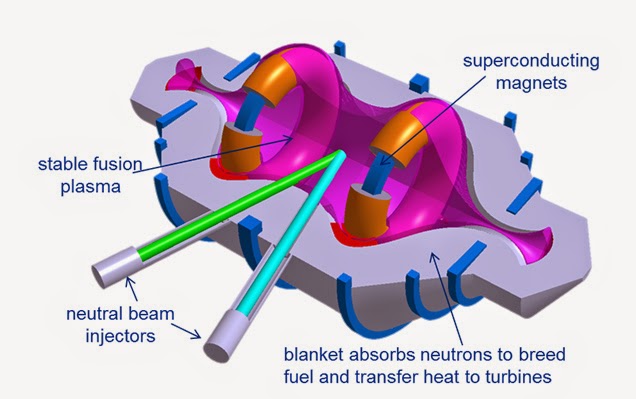
This is an invention that might possibly modify the civilization as we know it: A compact fusion reactor presented by Skunk Works, the stealth experimental technology section of Lockheed Martin. It’s about the size of a jet engine and it can power airplanes, most likely spaceships, and cities. Skunk Works state that it will be operational in 10 years. Aviation Week had complete access to their stealthy workshops and spoke to Dr. Thomas McGuire, the leader of Skunk Work’s Revolutionary Technology section. And ground-breaking it is, certainly: Instead of utilizing the similar strategy that everyone else is using— the Soviet-derived tokomak, a torus in which magnetic fields limit the fusion reaction with a enormous energy cost and thus tiny energy production abilities—Skunk Works’ Compact Fusion Reactor has a fundamentally different methodology to anything people have tried before. Here are the two of those techniques for contrast:

clip_image007

The old-style Soviet tokomak scheme of the International Thermonuclear Experimental Reactor, a huge system being constructed in France.

clip_image008

The Skunk Works’ recent compact fusion reactor design.

The crucial point in the Skunk Works arrangement is their tube-like design, which permits them to avoid one of the boundaries of usual fusion reactor designs, which are very restricted in the sum of plasma they can sustain, which makes them giant in size—like the gigantic International Thermonuclear Experimental Reactor. According to McGuire:

“The traditional tokomak designs can only hold so much plasma, and we call that the beta limit. Their plasma ratio is 5% or so of the confining pressure. We should be able to go to 100% or beyond.”

This design lets it to be 10 times smaller at the same power output of somewhat like the ITER, which is anticipated to produce 500 MW in the 2020s. This is essential for the use of fusion in all kind of uses, not only in huge, costly power plants. Skunk Works is committed that their structure—which will be only the size of a jet engine—will be capable enough to power almost everything, from spacecraft to airplanes to vessels—and obviously scale up to a much bigger size. McGuire also claims that at the size of the ITER, it will be able to produce 10 times more energy.

The one thing here to remind everyone is that Lockheed Martin is not a stupid dude working in a garage. It’s one of the world’s major aerospace and military corporations. McGuire also understands that they are just starting now, but he says that the architecture of this compact fusion reactor is sound and they will progress rapidly until its final operation in just a decade:

I remind you that the skunk works managed to eat all the $billions of X-33 money and did not produce a single x-plane; one the most spectacular failures of the x program since we learned nothing from it that high school solid geometry students did not know. There are still good people at Lockheed but it is not what it once was.

clip_image001[6]

EU investigation of Google

the article you quoted talks about Google ‘seizing control of the opensource ecosystem’ from the manufacturers.
It conveniently ignores how those same manufacturers have been leaving customers in a lurch by locking down phones so they can’t be upgraded without the manufacturers assistance (and then not releasing any updates), loading down the phones with unremovable bloatware, etc..
I’m not saying that Google is entirely in the right, but the article was rather biased

David Lang

clip_image010

Freedom is not free. Free men are not equal. Equal men are not free.

clip_image010[1]

clip_image012

clip_image010[2]

Busy; There Will Be War; Training Your Dragon

Chaos Manor View Monday, April 27, 2015

clip_image001

We had a busy weekend and I somewhat neglected this place, so I have catching up to do. I also got a lot accomplished.

Earlier this month I mentioned that my Panasonic Cordless Phone system (KX-TGE-270) worked quite well, mostly, but in my big old (1932) house the walls were well made, and I wasn’t getting dial tone in the back bedroom with the master station in my downstairs office. There were several things I could have done, but putting the master station (which broadcasts to the five cordless phones) in the kitchen or front hall where it would very likely have worked wasn’t one of them, because the master station requires a landline phone connection and a power source in the same place, and this house has very few such.

For twenty years and more I used a KIE wired phone system, but it is dying and replacement equipment is hard to find, so I bought the Panasonic Cordless system at Costco just before my stroke in December, tried to install it in late January, and have been fussing about trying to adjust it to my new way of life ever since. I wrote some of that a couple of weeks ago, and got:

Panasonic Phone Extender

This extender really helped my Panasonic cordless phone problems:
http://smile.amazon.com/Panasonic-KX-TGA405B-Extender-Cordless-Systems/dp/B003MOKUIS/ref=sr_1_1?ie=UTF8&qid=1429409331&sr=8-1&keywords=panasonic+cordless+extender

Barry Margolius

It happened to be on sale at Amazon so I ordered it instantly, and this weekend Eric and I installed it. It’s a small box not much larger than a deck of cards, with a wall lump power supply. I can be mounted on a wall or rest on a table.

The instructions are ambiguous and say among other things that the booster must be “registered”, but that turned out to mean registered to the master station sort of like Bluetooth, which is pretty simple. Better instructions can be found on line.

Once it was registered – that is, the master station and the booster see each other and have green lights – we looked for a place where there was power and the booster lights were green, the nearer to the back bedroom as possible. That turned out to be on top of the microwave in the kitchen. Now we have dial tone in the cordless phone in the back bedroom. It works. Our digits are complete.

clip_image001[1]

Eric was over Sunday, and we installed Dragon Naturally Speaking.  I am part way through tutorial and have not used it to write real text; I am hoping to learn it, and be able to produce considerably more. It seems awkward, but I have never dictated much.  When I first got into this racket Alan Dean foster urged me to learn to dictate: it was much faster than typing.  He has it transcribed; in my case I had the marked mss. professionally typed.  I never studied typing as a systematic skill, and I learned a part touch and part hunt and peck style, which was in fact a lot faster than most writers, about as fast as I could think.  So I stayed with it although I now wish I had taken Alan’s advice. But I am grinding this out today faster than I was doing last week, so it may all happen again – I’ll progress faster relearning to type than I will dictating.  We’ll just have to see.  But I will practice training my Dragon.

Installation went easily enough although the downloading took longer than I expected, probably because we were also updating Precious, the Surface Pro 3, at the same time, and apparently that was the entire operating system and took hours – hardly Dragon’s fault.

So now I am training my Dragon, or it’s training me, and we’ll see.  I am using a Plantronics Gamecom Pro headset, which is ancient but appears to work just fine.  And now it’s lunch time.

clip_image001[2]

Announcing There Will Be War, Volumes I and II, for Kindle and eventually all other eBook sources.

clip_image003

Volume I: http://www.amazon.com/There-Will-Be-War-I-ebook/dp/B00WONO0C0

clip_image005

Volume II: http://www.amazon.com/There-Will-Be-War-II-ebook/dp/B00WOM86I0

These are thirty year old anthologies, but the stories hold up very well, and surprisingly so do the essays. We will gradually bring out all nine volumes of this classic series. Classic doesn’t mean dull. The first Amazon reviews seem very good; I do not know the reviewers.  But I think the stories and essays are still relevant.  The principles of war do not change as much as you might think given the advances in weapons.

clip_image001[3]

I also got this, but I had already bought the Panasonic system:

Cordless phones

Jerry,

The second generation Uniden 900 MHz Spread Spectrum phones have remarkable range, the best of any I’ve ever used. On flat land I’d expect at least a mile. If the base was elevated, say on the second or third floor of a house, I would not be surprised to get two miles or more.

I base this on my experience in hilly land with obstructions, the acid test being when I had my brother in-law put the base in his house, ground floor, at the bottom of a hill. He got in his car and started driving, and the phone kept working. When he got over the big hill and down the other side, and then went into his parents’ milking barn — the basement, concrete, lots of metal piping, tanks, etc.

The phone worked flawlessly — and the distance from the base was about a half mile, with a huge hill in between.

He got back in his car and kept driving, and the connection finally gave out when he got to the intersection, probably another quarter mile or so.

So, if they can get about 3/4 mile range, in a moving car (no external antenna from that “rolling faraday cage”) with a massive amount of earth between the phone and the base, then they ought to work anywhere in your house.

I would think you could probably find one on eBay for twenty bucks or so. Let me know if you’d like me to nose around and get the pertinent model numbers for these phones (they made several in that series — single line, single line with caller ID, two-line, and so forth).

For whatever reason, none of their newer phones have anything even close to that range. I have no clue why, but that’s the way it is. I’ve never heard of any other brands either, matching that kind of performance.

[Anon]

clip_image001[4]

http://www.pbs.org/wgbh/nova/next/tech/silver-nanoparticles-could-give-millions-microbe-free-drinking-water/

Silver Nanoparticles Could Give Millions Microbe-free Drinking Water

Chemists at the Indian Institute of Technology Madras have developed a portable, inexpensive water filtration system that is twice as efficient as existing filters. The filter doubles the well-known and oft-exploited antimicrobial effects of silver by employing nanotechnology. The team, led by Professor Thalappil Pradeep, plans to use it to bring clean water to underserved populations in India and beyond.

Left alone, most water is teeming with scary things. A recent study showed that your average glass of West Bengali drinking water might contain E. coli, rotavirus, cryptosporidium, and arsenic. According to the World Health Organization, nearly a billion people worldwide lack access to clean water, and about 80% of illnesses in the developing world are water-related. India in particular has 16% of the world’s population and less than 3% of its fresh water supply. Ten percent of India’s population lacks water access, and every day about 1,600 people die of diarrhea, which is caused by waterborne microbes.

Microbe-free drinking water is hard to come by in many areas of India.

Pradeep has spent over a decade using nanomaterials to chemically sift these pollutants out. He started by tackling endosulfan, a pesticide that was hugely popular until scientists determined that it destroyed ozone and brain cells in addition to its intended insect targets. Endosulfan is now banned in most places, but leftovers persist in dangerous amounts. After a bout of endosulfan poisoning in the southwest region of Kerala, Pradeep and his colleagues developed a drinking water filter that breaks the toxin down into harmless components. They licensed the design to a filtration company, who took it to market in 2007. It was “the first nano-chemistry based water product in the world,” he says.

But Pradeep wanted to go bigger. “If pesticides can be removed by nanomaterials,” he remembers thinking, “can you also remove microbes without causing additional toxicity?” For this, Pradeep’s team put a new twist on a tried-and-true element: silver.

Silver’s microbe-killing properties aren’t news—in fact, people have known about them for centuries, says Dr. David Barillo, a trauma surgeon and the editor of a recent silver-themed supplement of the journal Burns.

“Alexander the Great stored and drank water in silver vessels when going on campaigns” in 335 BC, he says, and 19th century frontier-storming Americans dropped silver coins into their water barrels to suppress algae growth. During the space race, America and the Soviet Union both developed silver-based water purification techniques (NASA’s was “basically a silver wire sticking in the middle of a pipe that they were passing electricity through,” Barillo says). And new applications keep popping up: Barillo himself pioneered the use of silver-infused dressings to treat wounded soldiers in Afghanistan. “We’ve really run the gamut—we’ve gone from 300 BC to present day, and we’re still using it for the same stuff,” he says.

The entire article is worth your attention.

clip_image001[4]

How to Attract Female Engineers

By LINA NILSSONAPRIL 27, 2015     nyt

THE figures are well known: At Apple 20 percent of tech jobs are held by women and at Google, only 17 percent. A report by the Congressional Joint Economic Committee estimates that nationwide about 14 percent of engineers in the work force are women.

As a woman with a Ph.D. in biomedical engineering, I look at those numbers with despair.

Why are there so few female engineers? Many reasons have been offered: workplace sexism, a lack of female role models, stereotypes regarding women’s innate technical incompetency, the difficulties of combining tech careers with motherhood. Proposed fixes include mentor programs, student support groups and targeted recruitment efforts. Initiatives have begun at universities and corporations, including Intel’s recent $300 million diversity commitment.

But maybe one solution is much simpler, and already obvious. An experience here at the University of California, Berkeley, where I teach, suggests that if the content of the work itself is made more societally meaningful, women will enroll in droves. That applies not only to computer engineering but also to more traditional, equally male-dominated fields like mechanical and chemical engineering.

There is more in the article, but it is clear that the goal is to persuade more women to work in high tech – and presumably high stress – lobs.  Precisely what that does to the human race is not so clear.  If we are to have a bright future do we not need bright people? And if intelligence is in any large part inherited – current theory puts it 50% to 70% heredity – then what will the result be? It’s a deeper question than is usually asked. Perhaps we also need to give some thought to the future.

clip_image001[5]

House of Cards

Subject:

http://www.telegraph.co.uk/comment/11561629/Top-scientists-start-to-examine-fiddled-global-warming-figures.html

Jerry, if all of the FUD about AGW (or whatever buzzword they’re using

today) is a house of cards, as you and I suspect, this article suggests that it might be about to come crashing down:

http://www.telegraph.co.uk/comment/11561629/Top-scientists-start-to-examine-fiddled-global-warming-figures.html

Note that there are three different official records of global temperatures, only one of them shows the claimed warming. Naturally, that’s the one the High Priests of AGW point to, while ignoring the two that contradict their theory. This is not science, this is either religion or politics.

Joe Zeff

As the data become more precise, the faith in the models grows among believers. We know what we have always known: the Earth has been both warmer and colder than it is now, and in fact fairly recently.

clip_image001[5]

http://www.nytimes.com/2015/04/25/technology/robotica-cheaper-robots-fewer-workers.html?ref=technology

Cheaper Robots, Fewer Workers

By THE NEW YORK TIMESAPRIL 24, 2015

By Jonah M. Kessel and Taige Jensen on Publish Date April 24, 2015.

This is the first episode in a Bits video series, called Robotica, examining how robots are poised to change the way we do business and conduct our daily lives.

Faced with an acute and worsening shortage of blue-collar workers, China is rushing to develop and deploy a wide variety of robots for use in thousands of factories.

Waves of migrant workers from the countryside filled China’s factories for the last three decades and helped make the nation the world’s largest manufacturer. But many companies now find themselves struggling to hire enough workers. And for the scarce workers they do find, pay has more than quintupled in the last decade, to more than $500 a month in coastal provinces.

Chinese businesses and the government are responding by designing and starting to install large numbers of robots, with the goal of keeping factories running and expanding without necessarily causing a drop in overall employment.

Government rules limiting most couples to just one child halved the birthrate in China from 1987 to 2003. The birthrate then leveled off at a lower level per 1,000 residents than in the United States. So China has lots of workers in their late 20s, but an ever-shrinking supply of workers now entering the work force each year.

The main ages for factory labor in China and in other developing countries are 18 to 24. Compounding the labor shortage for China’s manufacturing-intensive economy is that workers are staying in school longer — much longer. And following a Confucian tradition that the educated do not soil their hands with manual labor, graduates overwhelmingly refuse to accept factory work, except in supervisory, design or engineering positions.

As recently as 1997, China had only 3.2 million undergraduate students. With the Asian financial crisis that year, China began expanding its universities quickly, in an attempt to offset job losses among young people.

clip_image001[5]

clip_image007

Freedom is not free. Free men are not equal. Equal men are not free.

clip_image007[1]

clip_image009

clip_image007[2]

Busy busy, busy; polygraphs; will our cell phones be smarter that we are?

Chaos Manor View Wednesday, April 22, 2015

clip_image001[1]

Niven and Barnes were over for a story conference, and we went to lunch at Ahi Sushi. Excellent lunch. Our Avalon novel is coming along nicely, and it’s time for me to do some of the work.

Thursday, April 23, 2015 : did a lot of reading and catching up, neglecting this place. I don’t much feel inspired by the news. There is an inevitability to what’s happening in the Middle East. And the European Union has filed a lawsuit against Gazprom for trade discrimination or some such.

Meanwhile, the first two volumes of There Will Be War, my anthology series, is about to be released. The essays are dated, being written in the days when the Cold War was a serious threat. The first two volumes will be available as an eBook in a week or so – final proofing is being done now – and a hardbound print edition of the first two volumes in a short time.

TWBWv1_480

I’m one of the proof readers. I have been amazed at how well most of the stories – it is more fiction than essays, after all – have held up. And the essays on principles of strategy are after all, only dated in their examples, not truth. They are as valid as they ever were.

And I’m working on 2020 Visions.  We’ll have that available in a couple of weeks.

clip_image001

clip_image001[1]

Lie Detectors?

Iran’s intentions could be clarified if the Supreme Leader and/or other prominent government officials had to take lie detector tests

Seriously?   I mean, isn’t the fact that “lie detectors” are as useful as ‘e-meters’, and a voodoo priest has better accuracy common knowledge?

Isn’t this why a fundamental rule of intelligence analysis is “Capabilities, not Intent”?

But considering that Iran has been less than 2 years from breakout for the past 30 years, there clearly *hasn’t* been any intent.

Best regards,

Mike Lieman

Well. that’s not strictly true.  Polygraphs – true polygraph, not the trick kits – with face and hand temperature and accurate measurements of breath and heart rate can give very good evidence of stress no matter how good the subject is concealing it. Inducing stress, and interpreting what it means.  My first job at the University of Washington was as a tech assistant to Dr. Albert Ax, who pretty well founded modern polygraphs. We did extensive studies on veterans at the VA hospital, and Al’s paper on the physiological differentiation of fear and anger was a classic.

Our equipment was primitive – vacuum tubes, 6L6’s not transistors, noise filters, very primitive – but we got results.  Again, interpreting those results is a skill, and takes experience to learn.  Things have got much better since the days of Galvanic Skin Response (GSR) using Wheatstone bridge circuits.

The same is true of Voice Stress Analysis equipment, which I not has gone off the radar, but still exists and I would assume makes use of modern computing power. Whether anyone at State knows of them or pays any attention to them is another story. I wouldn’t know.

Obviously diplomats will develop considerable self control if they stay in service – just as poker players had better if they are to stay in the game  — but very few can conceal all signs of stress from well designed equipment.  I would presume the Agency if no one else is aware of this.

clip_image001[2]

clip_image001[3]

The Internet of things doesn’t — and shouldn’t — exist

http://www.infoworld.com/article/2910610/internet-of-things/the-internet-of-things-doesnt-exist.html?phint=newt%3Dinfoworld_mobile_rpt&phint=idg_eid%3D41987714d7814e9694722378ebd74a82#tk.IFWNLE_nlt_mobilehdwr_2015-04-22

An open, fully connected environment is impossible and dangerous, which is why IoT is really a collection of separate networks

InfoWorld | Apr 21, 2015

A highly connected world where devices of all sorts intelligently use sensor data to be more efficient, adjust to changing conditions, prevent or at least flag problems, and optimize performance of themselves, workflows, and even personal health — that is the vision of the Internet of things.

Mobile security: iOS vs. Android vs. BlackBerry vs. Windows Phone

Google’s Android for Work promises serious security, but how does it stack up against Apple’s iOS and

Read Now

It’s a great vision, but despite all the hype in the last year, it does not — and may never — exist.

An intriguing subject of thought.  Yet I can imagine my car calling to warn me that I’m spending too much and will get him repossessed…

clip_image001[4]

EU investigation of Google

the article you quoted talks about Google ‘seizing control of the opensource ecosystem’ from the manufacturers.
It conveniently ignores how those same manufacturers have been leaving customers in a lurch by locking down phones so they can’t be upgraded without the manufacturers assistance (and then not releasing any updates), loading down the phones with unremovable bloatware, etc.
I’m not saying that Google is entirely in the right, but the article was rather biased

David Lang

I posted it because it was interesting, not because I agreed with it. I often do that when I have not thought through a news article. It gets me comments from people like you who have given it some thought.

clip_image001[5]

Intel Compute Stick now available: $149 for Windows version, $110 for Linux (ZD)

Summary:After debuting its PC-on-a-HDMI-adapter at CES, the chip giant is readying it for shipment — and has already delivered the first wave of units to tech reviewers.

By Sean Portnoy for Laptops & Desktops | April 23, 2015 — 05:10 GMT (22:10 PDT)

The concept of a “PC stick” — a processor and RAM embedded into a gum-pack-sized device that can connect to your HDTV via an HDMI connection — is nothing new, but when a company like Intel embraces the concept, a lot more people start paying attention.

http://www.zdnet.com/article/ces-2015-intel-introduces-compute-stick-with-atom-quad-core-cpu/

clip_image003

A Blueprint for Your Digital Afterlife

Re/code

We all know that we’re going to die someday. But what happens to our digital life after we’re gone?

A few months ago, a friend’s mother suddenly passed away. Her iPhone 5s was password protected, but no one knew the code. She had recently visited my friend and his family and used the iPhone to take several pictures with family members. Sadly, these are some of the last photos my friend has of his mother, but they’re all stuck on her iPhone.

Since then, my friend has been working with Apple to try to gain access to the photos. As the representative of his mother’s estate, he thought the process would be straightforward, but it is proving to be anything but.

 clip_image003

http://www.washingtonpost.com/blogs/innovations/wp/2015/04/23/the-coming-problem-of-our-iphones-being-more-intelligent-than-us/

The coming problem of our iPhones being more intelligent than us (WP)

By Vivek Wadhwa April 23 at 8:05 AM

Ray Kurzweil made a startling prediction in 1999 that appears to be coming true: that by 2023 a $1,000 laptop would have the computing power and storage capacity of a human brain.  He also predicted that Moore’s Law, which postulates that the processing capability of a computer doubles every 18 months, would apply for 60 years — until 2025 — giving way then to new paradigms of technological change.

Kurzweil, a renowned futurist and the director of engineering at Google, now says that the hardware needed to emulate the human brain may be ready even sooner than he predicted — in around 2020 — using technologies such as graphics processing units (GPUs), which are ideal for brain-software algorithms. He predicts that the complete brain software will take a little longer: until about 2029.

The implications of all this are mind-boggling.  Within seven years — about when the iPhone 11 is likely to be released — the smartphones in our pockets will be as computationally intelligent as we are. It doesn’t stop there, though.  These devices will continue to advance, exponentially, until they exceed the combined intelligence of the human race. Already, our computers have a big advantage over us: they are connected via the Internet and share information with each other billions of times faster than we can. It is hard to even imagine what becomes possible with these advances and what the implications are.

Doubts are understandable about the longevity of Moore’s Law and the practicability of these advances. There are limits, after all, to how much transistors can be shrunk: nothing can be smaller than an atom.  Even short of this physical limit, there will be many other technological hurdles. Intel acknowledges these limits but suggests that Moore’s Law can keep going for another five to 10 years.  So the silicon-based computer chips in our laptops will likely sputter their way to match the power of a human brain.

Kurzweil says Moore’s Law isn’t the be-all and end-all of computing and that the advances will continue regardless of what Intel can do with silicon. Moore’s Law itself was just one of five paradigms in computing: electromechanical, relay, vacuum tube, discrete transistor, and integrated circuits. In his (1999) “Law of Accelerating Returns,” Kurzweil explains that technology has been advancing exponentially since the advent of evolution on Earth and that computing power has been rising exponentially: from the mechanical calculating devices used in the 1890 U.S. Census, via the machines that cracked the Nazi enigma code, the CBS vacuum-tube computer, the transistor-based machines used in the first space launches, and more recently the integrated-circuit-based personal computer.

He goes on to describe S-curves, which Possony and I described in some detail in Strategy of Technology in 1969. Of course computing technology increases, but you can only compute what you have some understanding of; although data mining may be a counter example.  We have discovered some laws by accident. Statistical dragnets can be useful.  They can also be deceiving.

clip_image003

clip_image003

Freedom is not free. Free men are not equal. Equal men are not free.

clip_image003[1]

clip_image005

clip_image003[2]