Chaos Manor View, Saturday, August 6, 2016
Liberalism is a philosophy of consolation for the West as it commits suicide.
James Burnham
If a foreign government had imposed this system of education on the United States, we would rightfully consider it an act of war.
Glenn T. Seaborg, National Commission on Education, 1983

1830: partial, to be continued tomorrow.
The wall is done, the bricks are hauled away, and all is well at Chaos Manor. Of course I typed akk rather than all. I also told autocorrect to always correct that, which meant it was a certain amount of work to get the incorrect form in this text.
August 3 was my oldest son, Alex’s birthday. Tomorrow is my birthday, but we don’t have anything planned. I already bought myself some new computers and paid my way to the WorldCon in two weeks, so I don’t need presents. We may go eat out, and it’s barely possible that my second son Frank and his partner Tiger will show up unexpectedly, which would be very nice. Progress is being made on the novels I am working on, particularly the Interstellar Colony series novel with Niven and Barnes.
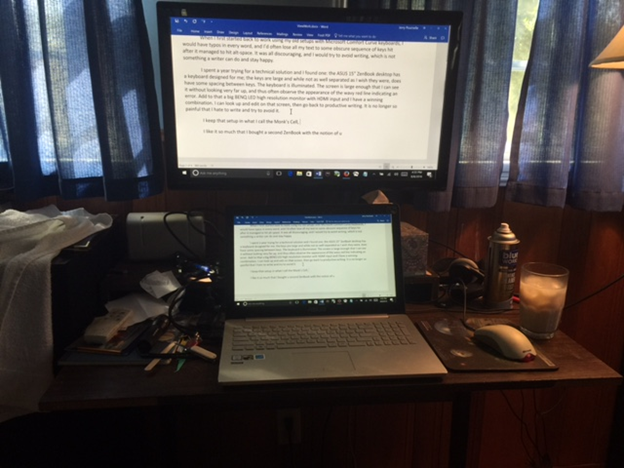
Of course something always goes wrong. This wouldn’t be Chaos Manor if everything went right. First thing I noticed is that the floor lamp that illuminates the keyboard up here in the Monk’s Cell was not working. I don’t suppose I have ever changed the bulb and I think I started working up here on Starswarm, so I guess it’s about time, but I have painfully to go back downstairs, hunt up a bulb, and climb back up to fix that, so I haven’t done it yet: I did order some more bulbs, which of course cost more for less light since the improvements, but at least they come in Amazon Prime so I won’t pay for shipping.
Microsoft has improved Outlook and Word, so I am having problems getting my work done; I had to shut down Word with Task Manager after I attempted to save this in the TempWork file I keep on my OneDrive; it just trundled endlessly and I thought I’d lost the work I had done because it was still trundling minutes after the Save As – overwrite existing copy maneuver. So I used task manager to stop it, and started Word again. It wouldn’t start, did I want it started in safe mode? I said yes, let it start, closed it without any further activity, started it again, and not only did it come up, it asked if I wanted TempWork restored. When I told it yes, up came the file that I had attempted to save, and all’s well. Cost some time, but Microsoft is like that. It usually just works, but then they improve it. I wish they’d make fewer improvements.
But all this taught me that I need that lamp illumination of the ASUS 15” ZenBook keyboard that I use for more and more of my work now. I’d do even more on it, but I can’t install LiveWriter, and I can’t seem to get Outlook to install. That latter may be because I don’t have Ethernet up here, only good wireless, and Microsoft downloads are big and take a long time; it’s also barely possible that LiveWriter won’t install unless you have Outlook going. All I know is that I go through all the hoops, and when I’m finished I get the helpful message that LiveWriter couldn’t install for unknown reasons. OK? But I couldn’t get the system to install Outlook. I have another ASUS ZenBook downstairs – I’ll get to why in a moment – and I did get Outlook running, but when I told it to send/receive to update the Inbox it trundled for minutes and said it could not connect to the server. Since the other machines on Outlook saw the test message that the installer saw and there were a lot of Inbox messages on there up to about the time I tried to install it, it’s pretty clearly a Microsoft problem. Anyway I wasted enough time on that, and came up here.
I have a ton of mail I need to deal with. We have a very good discussion of Free Trade, and I’ll try to draw some conclusions after presenting it. It’s very clear that Free Trade can be beneficial under some conditions – and it is also clear that the US lost a lot of good manufacturing jobs and manufacturing ability in the past few decades, and Free Trade was responsible for some of that. We’ll have a discussion.
Jo Anne has been doing her usual research on women in Muslim land, and has come up with some facts about Captain Kahn’s father. I generally rely on her to be meticulous about facts; of course she makes no secret of her opinions.
I have two ASUS ZenBooks because the ASUS keyboard is far and away the best I have found for my typing situation. Before my stroke I was a very fast and not too sloppy touch typist, and I wrote while looking at the monitor so that I saw what I was writing as I typed it. Since the stroke I am a two finger typist and I must stare at the keyboard. In the old days I preferred the Microsoft Comfort Curve keyboard, but I can’t use that for two finger typing. The keys are far too close together, and I always hit more than one. When I type a line and then look up all I see is a line of nonsense I must painfully edit into text; by the time I have done that I will have forgotten what I was going to write next. Writing is painful. With the ZenBook the keys are separated by a fair distance, and are large, while the screen is close enough that I can sometimes see my mistakes at a glance. I have a good LED monitor above where the monitor has always been in the Monk’s Cell — it’s a new BENQ Eric got at a sale at Fry’s and I find it more than satisfactory so I can look up at the screen and edit using the mouse after I finish a paragraph, which typically will have no more than one typo in each line, rather than at least one in every word.
I can’t get the ASUS 15” ZenBook keyboard separate from the ZenBook. I now have one up here, where I do quantity work, and I love it; and I am experimenting with the notion of using laptops to control more powerful computers. The ZenBooks I have are very fast so there’s not a lot I need more speed for, but sometimes I need the speed and enormous disk space. More on that as time goes on.
It’s close enough to dinner that I’ll go post this – I can’t get LiveWriter to install on this ZenBook so I will have to go downstairs and use a desktop. Thanks a lot, Microsoft. Eventually I’ll get something new to use to post my journal with. As you surmise, I’m writing this in Word and saving it on OneDrive so it’s already on all my downstairs machines. Incidentally, Barnes, Niven, and I are working together on a master copy that resides on Steve Barnes’s OneDrive. I open it in Word on this ZenBook and just write. It works like a charm, and I’m using my own Word with my dictionaries and autocorrect. For that improvement I heartily thank Microsoft.

A safety reminder: take heed.
Another hacking approach…Dropbox
Yesterday I received an email from a Yahoo group of which I am a member. The email included something purporting to be a Dropbox item, which I should open.
This seemed unusual so I inquired about it with the credited sender. He responded that he had been hacked and I should not open the Dropbox item. So I didn’t.
Charles Brumbelow
I urge you to follow this link and read this. It shouldn’t take long. 
http://www.theimaginativeconservative.org/2013/10/ten-conservative-principles.html
Rod Montgomery==monty@starfief.com
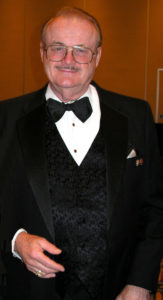
As you probably know, I was a student and protégé of Russell Kirk, and he stood as Godfather to one of my sons. He was my colleague at Pepperdine for a year.
If you are concerned with the question of what is conservatism, this may be enlightening. Understand, conservatism, at least as seen by Burke and Kirk is not an ideology nor is it exactly a movement. It’s more a way of looking at the world. I would call it a kind of realism, but that may not be an acceptable definition to you. This may help define it for you.
Trump on Russia
Well this is interesting:
<.>
Republican presidential candidate Donald Trump is suggesting the U.S.
accept Russia’s annexation of Crimea if it would lead to better relations with Moscow and stronger cooperation in fighting Islamic State militants.
</>
https://www.newsmax.com/Newsfront/trump-says-us-should/2016/07/31/id/741400/
Maybe Mister Trump doesn’t understand geopolitics but the United States accepts Russian annexation of Crimea; clearly, the United States can do nothing but accept the annexation of Crimea. If the United States did not accept this, we would see actual conflict as opposed to pressures and levers that were looking for an excuse to be applied because of Russia’s economic war against us.
All they did was give us an excuse to crush their economy and discourage their non-linear war. I hope it was “worth it” for Putin.
But, I too would prefer better relations with Russia so why not put some language around this and chant a little bit and see what sort of public perceptions we can conjure? And then we can see what cooperation is possible. So, perhaps Mister Trump approaches this in the sense of a negotiation and maybe he’s a better geopolitical player than he appears at first glance?
We know that Hillary Clinton lost her cool and went after an old man who blew up a plan decades ago, only to tear down the wall between the terrorists and Europe while helping flood Europe with refugees and terrorists. Regardless of all the other nonsense surrounding Benghazi, the only point of geopolitical significance is the one I just mentioned, and — strangely enough — Qaddafi himself warned us that this would happen if we killed him and said we would be stupid to do it and he would laugh.
I suppose, in this country, if Qaddafi says orange juice is made from oranges then I must denounce his statement to remain a “good American”
or whatever, and Qaddafi was a jerk who committed human rights abuses but none of that stops him from being correct.
◊ ◊ ◊ ◊ ◊
Most Respectfully,
Joshua Jordan, KSC
Percussa Resurgo
Putin’s Russia is considerably improved from the rapacious 1990’s which so dismayed him. His objectives are pretty well those of traditional Russia, some of which are in opposition to the interests of the United States, and some not.
The fertility rate is growing, the middle class is growing, and life is much better for the average Russian than it was under communism; that was not true until recently. Russia’s goals are the absorption of Russians, then pan-Slavism. Neither of these goals threatens us. There are many common interests to negotiate. Obama’s attempt at reset was a good idea but unskillfully executed and of course Mr. Clinton inadvertently fostered enmity with Pan-Slavic Russia by choosing the anti-Slav side in the Balkan Wars in which we had no interest other than stability. There was no clearly morally superior side in the Balkan Wars. When we ruined the economy of the Lower Danube by dropping bridges and making that key waterway impassable, we made few friends in Bulgaria and Rumania, who weren’t even in the war.
Russia has reason to fear us. We have no way to defend the nations surrounding Russia which we have guaranteed in NATO except “massive retaliation at a time and place of our choosing.” We certainly do not have conventional forces capable of keeping the Russians from getting to Warsaw in days or even hours. Whether we have the forces for massive retaliation is of course a highly classified secret, but it is not secret that we no longer have SAC. Still, the threat remains.
I suspect a lot of good for us could come from skillful and serious negotiations with Putin, if conducted by someone he respects.
The ruler of Libya did all that the United States asked of him. It was not enough. Libya is no longer stable, and has become a base for a power that is in a declared war with the United States. No person is more responsible for this situation than was the then Secretary of State of the United States.
Russia is not our traditional enemy.
New Russian Tank is Significant
This could unbalance much:
<.>
“We discovered that no matter how skillful the crew, the tank would get up to ten hits,” Pukhov said during a luncheon at the Center for the National Interest in Washington, D.C.—which is the foreign policy think-tank that publishes The National Interest—on July 26. “Even if you have perfect armor—active, passive. In one case it will save you from one hit, in another case from two hits, but you’ll still get five hits and you’re done.
<.>
Pukhov cited a particular battle in Eastern Ukraine where—even when operating under ideal conditions—a tank force fighting under the banner of Kremlin-backed separatist forces was all but annihilated by rocket-propelled grenades. If even a small force of anti-tank missile-equipped infantry could decimate a tank column, the take-away for the Russians was that they needed to rethink the entire concept of the tank.
<.>
If and when the Terminator is ultimately fielded, the vehicle would be able to engage large groups of massed infantry in built-up areas with a combination of missiles and automatic cannon fire. “We need it badly,” Pukhov said. “Believe it or not, we’re not going to project force, we need to protect our territory.”
</>
http://nationalinterest.org/blog/the-buzz/russia-about-make-tanks-we-know-them-obsolete-17158
Wow! When the article said “engage large groups of massed infantry in built-up areas with a combination of missiles and automatic cannon fire”, after thinking about our men, I thought about Chinese infantry.
This seems well suited to China.
◊ ◊ ◊ ◊ ◊
Most Respectfully,
Joshua Jordan, KSC
Percussa Resurgo
A strategy of technology would not let Russia or anyone else have better weapons systems than the United States. Apparently this lesson is no longer taught in the Academies. Alas. We had the largest stimulus bill in our history – Barrack Hussein Obama was able to spend more on economic stimulus than all the previous presidents in US history combined – but apparently none was used to pursue our interests in military technology. We sow the wind.

Free Trade
Let me begin by reminding everyone that while unrestricted Capitalism and absolutely free markets are the best known way of producing the most and cheapest stuff, they inevitably lead to the sale of human flesh in the market place. If you do not think that having cheap stuff and baby parts for sale in the public markets is a desirable goal, then you put some value ahead of unrestricted free markets. How much restriction is needed is what we are discussing.
Comparative advantage doesn’t exist?
Dear Dr. Pournelle,
One or another of your correspondents recently made the rather breathtaking announcement that, other than having a lot of farmland, there is no such thing in international trade as “comparative advantage”, and thus the term should be abolished.
I commend the correspondent on the bravura and dash with which he managed to say something silly and make it seem the height of considered wisdom, but style don’t make it so.
So a country with a boatload of iron ore and coal has no comparative advantage in making steel over a nation with lesser quantities and/or grades of cola band iron ore?
So my little pocket Swiss Army knife that I have used for twenty-five years, and is still as sharp as when purchased though never sharpened is as good as it is due to the skill of the Swiss craftsmen who designed and manufactured it, and their skill came from the superb schools and high standards of their national work ethic, while the Look Alike pocket knife I once bought for a dollar, which was made in China, was so dull it literally would not cut paper, and the steel was of such a low quality that the “file” would not even effectively wear down a ragged fingernail was the product of the Chinese work ethic and school system producing workers who knew how to make it “look The Same” while not being able to do anything like the same job is in no way evidence of a comparative advantage for the Swiss in the production of such multi-tools?
Switzerland has no comparative advantage because of their educational system and culture?
Bahahahahaha…
And we thought there was no comedy on Chaos Manor!
May your wall soon be up again, your drains clear, and your typing flow like Niagara!
Comparative advantage is a theoretical concept. Sometimes, as in the examples you give, the advantages are obvious. The United States with its splendid public education system through the first half of the Twentieth Century possessed an advantage over nearly everyone else for a very long time. The “Protestant Ethic” that was pretty universal didn’t hurt either.
However, comparative advantage can tricky; a freely mobile population, with no roots, and willing to work for not much can have an enormous advantage, and offer goods at low prices; but if you must ship them the machinery and furnish them the capital to build the plants that let them compete with you, who is served? Certainly lower priced goods benefit everyone, but now you must support the workers who can no longer earn the higher wages they were getting. They may have to be bailed out of mortgages. If they lose their jobs they must be supported, somehow, and a bureaucracy of people whose job it is to take care of welfare for the unemployed; it is in their interest that there be as many unemployed as possible. The capitalists who financed shipping the manufacturing equipment to the lower wage country now lobbies for continuing that process. You need to be sure your schools are up to snuff, but there is now a group whose income depends on not having educated workers. And so forth.
The country that competes with the low wage competitor faces problems it has not seen before; and if it doesn’t understand the situation – as who, really does – it can lose any comparative advantages it once had. Comparative advantage works well in theories, but it assumes conditions that do not always apply and may not be desirable. To that extent – assuming labor mobility and placing no value on community stability – Free Trade is a radical rather than a conservative idea.
“What, precisely, is being conserved here?”” /
Dear Jerry,
I enjoyed our diversion into so-called “Free Trade.” This topic is one of the two missing sections in Charles Murray’s “Coming Apart”. Immigration is the other one. But as is well known, Murray’s neocon paymasters at the American Enterprise Institute are two fisted Free Traders and open borders loons (except where the Zionist State of Israel is concerned).
I think your organizing question there – “What, precisely, is being conserved here?” – is an excellent analytic premise to use in approaching all aspects of post-WWII “American Conservatism”.
For myself I long ago came to the conclusion the reason this Conservatism construct failed to thrive was it fundamentally lacked genuine roots in the original historical America, a now already extinct polity. Put another way, its foreign parts content from the very beginning was always too high.
Best Wishes,
Mark
free trade
I’m not a professional economist, and even less an economic statistician; please take these comments as those of an interested amateur, and as suggestions for the kinds of things that may be worth looking at, in terms of making a case for not interfering with free trade.
It looks to me as if this is a classic Bastiatian case of “what is seen and what is not seen.” Take your American made car that would cost you $5000 more. Not everyone can afford that; there would be people who put off buying a new car. But when you do, there’s $5000 that you WON’T be spending on buying any other goods or services; you have to give those purchases up to pay the cost of a more expensive car. Add up a lot of people like you, and that’s a possibly substantial hit diffused through the whole US economy in such a way that it’s not acutely visible anywhere.
There’s also the economic impact of your not buying products made elsewhere. Right now, China is the country everyone looks at as taking away American jobs. But, for example, the US exports something like $29 billion dollars’ worth of soybeans; and a look at a recent table showed China as buying 890 million bushels, much more than the rest of the top five buyers together. They’re largely using their exports to the US to pay for that. If they can’t export to us, they can’t buy soybeans either; and there goes a big share of $29 billion worth of American jobs and farms. The same presumably applies to other goods China buys from us; I looked up soybeans because I knew about them.
One of the key ideas of classical economics was Say’s Law, which says that a general glut (general overproduction that makes goods unsalable) is impossible. Kaynes based his economics on a rejection of it; but Keynes’s phrasing of it was “supply creates its own demand,” which is not what Say said and is obviously absurd (if I make mud pies, that doesn’t create a demand for mud pies). What Say said was that the actual demand for one commodity is necessarily the supply of one or more other commodities. If you have only one commodity (as Keynes’ wording suggests), you can’t meaningfully speak of supply and demand; once you have two, they can’t both be in oversupply, and the extension to a larger economy is just mathematical induction. What you have, instead, is oversupply of some products (and the forms of labor that produce them) and a need to shift to other forms of production in particular, to invoke a different classical economist, the ones where you have a comparative advantage. The US clearly does have a comparative advantage in some areas; consider, for example, that China imports a huge quantity of soybeans from us!
It doesn’t help make those adjustments, though, when you set up frictions to labor shifting to new parts of the economy, or when you subsidize the immobility of labor. The US isn’t as far gone as, say, Germany, where (or so I have read) letting an employee go requires a year’s notice and a year’s severance pay. But we have a lot of benefits for those who don’t work; and I’ve seen at first hand how those make it really hard for people to make themselves economically productive.
I myself have been a freelancer since my copy editing job was outsourced to India. And it’s reduced my income, and is continuing to do so. On the other hand, I’m typing this on a Mac Mini that cost me less than $1000. How much would I have to pay for a computer if all the labor of making computers were done in the US, and if we had protective tariffs to keep it so? Would we even have a computer industry if those costs had to be paid? There are entries on both sides of the balance sheet. I personally would rather have creative destruction; but then, I’m a capitalist and not a conservative, so we may disagree.
William H. Stoddard
I expect that Mac would cost you 1200, but that’s a guess. We would also have the in-country capability of making them if China didn’t – or couldn’t – trade with us any more. But that is a guess. Certainly Apple seems to be convinced that it is better to have their workforce in China. It is obvious that regulations concerning employment raise the cost of labor, and thus provide an incentive to have macs and sweat sox made somewhere the Department of Labor can’t go; and this lets US companies escape those regulations.
Detroit
Dr. Pournelle,
I write about cars, mostly automotive history, and I’m a native Detroiter. Tariffs and similar protections for the American auto industry would have been a disincentive to improving their products and being more competitive. The changes to the industry and to this city have been wrenching, but today Ford, GM and Chrysler make the best products they’ve ever made. I doubt that would be the case had protectionist tariffs been in place.
I want Americans to have access to the best products in the world. Tariffs hinder domestic economic development because they provide barriers to American businesses buying what they need. If the tariffs are high enough, some products will not be manufactured here because their producers can’t afford imported equipment and supplies.
Ronnie Schreiber
I fear I am unable to infer any rules from this. I presume you would, as would my friend David Friedman, be in favor of unrestricted free trade.
Interstellar Colonization
“Well, if it is impossible to build a thriving economy isolated from everyone, then of course interstellar colonies are impossible; and surely that is not true?”
The subject makes a nice diversion from current national politics and world events.
Based on lunchtime napkin doodling, I figure colonization for interactive economies is impossible unless we: (A) discover FTL travel, or (B) significantly increase human longevity by at least several multiples, or (C) establish multi-generational supply trains between habitable star systems.
Right now, faster than light travel is still barely theoretical; not even as potentially feasible as commercial hot fusion. Increases in human longevity are becoming possible, although as greater than whole multiples is still questionable; so being able to run a multi-decade trade exchange is not going to be easily conceptualized by predominantly short-term thinking humans. And multi-generational supply trains are not going to be at all reactive to changes in the market. What good is “A Gift From Earth” when a colony has raced past the level of Earth technology? Or for that matter, what good is a 20-year supply train of interstellar petroleum shipped from Alpha Centauri when we’ve discovered a cheaper means of mass producing it, or a better lubricant, here on Earth?
The transmission of ideas and information between worlds may be of value, but it seems to me that the value of such is going to be one-sided in almost all cases. A workable economy begs for a relatively equal exchange of value, a quid pro quo, to exist.
The only current justification for the establishment of slower-than-light interstellar colonies is for lebenstraum for the colonists who can afford to go, assuming they survive to get there, or their children if multi-generational. There’s no benefit to any other socio-political organizations short of expansion and continuation of the baseline human species. (Which if I remember correctly, was the justification for the National Geographic Society colony to Tau Ceti in your novel.) While I consider that to me a very moral justification (in the spirit of Mr. Heinlein’s definition of morality); actually selling that to people to pony up blood and treasure for it seems rather problematical.
Michael Houst
You must know things I do not. I have no problem at all believing that enough people could be found who would man an interstellar colony ship. I think a generation ship (with rotation to provide gravity I would have to assume) would be less attractive than cold sleep, but still I think a population could be found.
First, of course, we would have to have colonies off Terra; I suggest the first would be a Moon Colony; and I know we could find volunteers for that.
isolated economies –
You said:
“Well, if it is impossible to build a thriving economy isolated from everyone, then of course interstellar colonies are impossible; and surely that is not true?”
If interstellar colonies did exist and throve in isolation, then presumably they would thrive because of the isolation. Otherwise, what would be the attraction?
Nations which are earth-bound, on the other hand, must exist in competition with other earthly nations. Even if we do not wish to acknowledge the competition, it still exists. The modern history of China (and Japan as well) is an excellent case study of the consequences of long-term isolation.
Neil
More Free Trade ()
Dear Dr. Pournelle.
First of all, congratulations on getting your wall built! Second, I’d like to thank you for reposting my thoughts. I’d like to respond to your comments, if I may.
“Well, if it is impossible to build a thriving economy isolated from everyone, then of course interstellar colonies are impossible; and surely that is not true?”
I would argue that the opposite is true: If interstellar trade is
not possible, neither are interstellar colonies.
Consider the original thirteen colonies: Most of them were charter
or proprietary with the explicit purpose of making money for the investors in the UK. It required a tremendous infusion of venture capital to start one, and the payoff came via a captive market for manufactured goods, and a source of cheaper raw materials. Thus, I contend that it is market forces, which will drive the eventual colonization of the stars. And who’s going to launch all that capital away in a rocket if there’s no vessel to carry stuff back and recoup the investment?
Thus, just as the US was not possible before sailing ships made transatlantic trade possible, so we will need a mechanism capable of interstellar trade before there can be interstellar colonies.
The old Technocracy organization once tried to analyze economies and determined that North America could have a thriving high tech economy with no foreign trade … but do you really think that the United States could not survive without foreign trade?”
And this is why I asked my serious question: Theory aside, has this ever been done successfully?
So far, the first example that comes to mind is China. It successfully walled itself off to become a Heavenly Kingdom for hundreds of years.
It worked very well, until it didn’t. Competition, trade, and innovation flourished in Europe until they were eventually able to catch up and surpass the Chinese. Then the Heavenly Kingdom became prostrate before the European powers, with various settlements and bits chopped off in places like Canton, Macao, and Hong Kong. It would take them fifty years to gain their independence — and when they became prosperous, it was through trade.
So I would answer that the US could be self sufficient if we really could launch into space and leave all the other nations of the earth behind. As it is, our isolation would allow the other nations of the world to surpass us technologically, and eventually suffer China’s fate. China had all the resources of a high-tech civilization also, but because they weren’t trading, they weren’t able to leverage them to best effect.
There’s also the small fact that isolating ourselves from the rest of the world is easier said than done; thanks to the internet, air travel, and all other modern technology it becomes harder and harder to keep outside influences out. The US is a centerpiece of trade, and not just for the upper class. Visit a Walmart; a majority of everything on those shelves is from some other country. Stopping that by force and stimulating home grown industry would be no easy feat; the term “planned economy” comes uncomfortably to mind.
Respectfully,
Brian P.
And yet I think there will be interstellar colonies and the first attempt will be made in this millennium.
Tariffs < >
Dr. Pournelle
If Brian P. can argue for Free Trade with an historical example, I can argue against with an historical example.
The United States became the greatest industrial power in the world with tariffs in place. Did the poor survive those tariffs?
Live long and prosper
h lynn keith
Sunday Night 2350
Trump
Dear Mr. Pournelle;
I note with some dismay recent mutterings regarding Mr. Khan. Assume for the moment his imperfection: so what? He is not running for president. I am not being asked to vote for him.
We are being asked to vote for Donald Trump. What have we here? A high-profile, abrasive candidate who is indeed running for president. He is criticized by a Gold Star parent. (None of whose comments, as far as I can tell, were false.) Any candidate with class would have simply been silent. It is, I believe, still part of our consensus that the parents of a fallen soldier deserve respect. Let it be. Move on.
Donald Trump’s response was an immediate demand for an apology, and a claim that Mr. Khan had “viciously attacked” him. Mr. Trump, of course, being known for his courtesy and respect for others. (Heavy sarcasm.) Not content with this, he gratuitously attempted to mock Mrs. Khan; who had to that point said nothing whatever about him. And he dragged this out for days.
Now we get the opposition research; against Mr. Khan, a private citizen. So much for “Donald Trump, Defender of the Little Guy.”
Comments upon Mr. Khan are at this point irrelevant. Once again, he’s not running for anything. The only this pertinent to this election is what we have learned from this episode about the character of Donald Trump.
Yours,
Allan E. Johnson
So far as I know, no aspersions have been made about Captain Khan, who died years ago upholding and defending the Constitution of the United States. It is his father that Mr. Trump has issues with. His father, however, apparently does not accept the Construction, and prefers the Moslem Brotherhood and Sharia law. I have no evidence you don’t have regarding Captain Kahn’s convictions on those matters, but I do know the oath of allegiance he had to take to obtain a commission as an officer of the United States, and that he freely took that oath swearing that he had no mental reservations, so I presume he did not approve of the Muslim Brotherhood, nor did he prefer Sharia Law. But it is of little matter when considering which of the two candidates to choose for president; and the fact is that a vote for anyone other than Trump is a vote for Mrs. Clinton and the Clinton Foundation.
I would not advise Mr. Trump to say anything about the senior Mr. Kahn, but that is hardly the point. I would not have voted for Andy Jackson of Tennessee in his election running against John Quincy Adams; but I certainly would have voted for Jackson had he been running against Aaron Burr. Jackson said many rather appalling things, but the Republic survived. Mr. Trump has said he will appoint a conservative legal scholar to the Supreme Court. We know that his opponent will appoint a liberal. Mr. Trump wants to shrink government; we know that his opponent has been a party to its growth. I could continue with a list of things the Obama Administration has done, and we can reasonably conclude that a Clinton Administration will continue them.
We are afraid Trump might do some things we disapprove of. He probably will. We know that Mrs. Clinton has done many things that I, at least, disapprove of. We can be quite certain that she will do many more if elected.
http://www.breitbart.com/2016-presidential-race/2016/08/01/clinton-cash-khizr-khans-deep-legal-financial-connections-saudi-arabia-hillarys-clinton-foundation-connect-terror-immigration-email-scandals/
Khizr Khan, Humayun Khan, and all the others
Humayun Khan stood up and defended the United States of America. His father, Khizr, has been here for a long time, at DC law firms and such with strong financial links to Saudi Arabia, the source for much of the financial backing for global Jihad. Breitbart reports here:
Clinton Cash: Khizr Khan’s Deep Legal, Financial Connections to Saudi Arabia, Hillary’s Clinton Foundation Tie Terror, Immigration, Email Scandals Together
“http://www.breitbart.com/2016-presidential-race/2016/08/01/clinton-cash-khizr-khans-deep-legal-financial-connections-saudi-arabia-hillarys-clinton-foundation-connect-terror-immigration-email-scandals/”
And Jihadwatch amplifies on this here with some interesting sources from the umma:
Robert Spencer in FrontPage: Khizr Khan, Servant of the Global Umma
“https://www.jihadwatch.org/2016/08/robert-spencer-in-frontpage-khizr-khan-servant-of-the-global-umma”
Khizr had decades to stand up and declare his anti-terror stance in vigorous terms. Silence. Khizr had nearly 15 years since 9/11 to stand up to loudly and unambiguously declare his anti-terror stance. Silence. Now, in support of his darling Hillary Clinton he lies to us about Islam and the Qur’an. What else can I call it in the face of the quotes from Islamic scriptures provided by Mr.
Spencer other than a flat direct lie?
{^_^}
And finally we kill off the last shreds of Khizr Khan’s credibility
He does NOT believe in our Constitution. He believes in Sharia law and has stated so on the record. Sharia law is the antithesis of our Constitution.
Khizr Khan Believes the Constitution ‘Must Always Be Subordinated to the Sharia’
http://www.breitbart.com/national-security/2016/08/02/khizr-khan-constitution-sharia/
And just think, Hillary supports him. Should we support Hillary? H-e-double toothpicks no!
{^_^}
The news media seems not to have carried all of the story. I would prefer that Mr. Trump not get involved in such matters, but I do share his concern that bringing in more people who reject the Constitution and prefer Sharia Law to Western Tradition and our version of the Common Law is not wise. Captain Kahn accepted an Army commission and died in defense of the Constitution; we were fortunate to have him. I cannot believe we were fortunate to have his father here.
Free Trade – Counter-example for Brian
Dear Dr Pournelle,
I remember raising the issue of the folly of Free Trade on your website over ten years ago, which result in much interesting debate. However, I think that this dogma of free trade has been having fundamental effects, that go beyond economics and that overtime directly threaten the security and stability of the developed world.
Firstly, I would like to directly address the issues in Brian P Grand Economic Theory email:
1) Global innovators can out-compete local industries – Yes, but this is not the result of innovation (New designs, concepts etc.), but lower standards for employment, product standards and access to cheap funding from state sponsored financial institutions. If I am wrong, then it should be possible for others to provide a number of examples of innovation to demonstrate my error.
2) Trade Tariffs impact the low paid disproportionately“ True but why are the numbers of low paid jobs increasing, whilst those in middle to high income roles declining in the US and elsewhere in the developed world. The impact of exporting high value/high wage jobs has reduced the US to a two tier economy, the vast majority being either under-employed or employed in low value/low paid jobs and with an ever shrink proportion of population in highly paid positions, often generating little or negative value (The Finance Sector being a prime example). This is not just a recipe for economic failure and the death of the founding concept of the American dream – Work hard and anyone can succeed – but is sowing the seeds of revolution as the success of Bernie Saunders and the rising in the belief in Socialism amongst millennials shows.
3) Tariff protect business from the need for innovation – There is perhaps some truth to this, but what level of innovation has been demonstrated by Chinese or other developing nations. New ideas and concepts still flow from Developed nations (Particularly the US) and are at most refined by developing nation businesses and at worst stolen and produced in low cost and low regulation economies.
As in many economic theories Free Trade ignores the real world impact of human behaviour. Developing nations circumvent WTO trade rules and automatically stabilising factors by providing cheap finance (Directly and indirectly by cross subsidization), impose non-tariff barriers such as control on ownership, restricted market access (India) and by currency manipulation. This is not a good approach for the Developed World and I would strongly suggest it is also failing the developing world too where average incomes have increased by a fraction compared to the growth in income of their own elites.
Does any of this matter?
Yes, it does! The first order impact is physical, the decline of industrial strength which is a key, if not the key factor and measure of national strength and security. The secondary, but perhaps more significant effect can best be described as a “morale†effect.
“Physical Effectâ€
Industrial strength in the modern world IS the measure of a nations power and the most important factor in national security. If anyone doubts that in a prolonged conventional conflict that China would now prevail against the US and its Allies I suggest they look at production figures in any area, but the comparative figures for steel, ship building and chip production are particularly shocking. The US is being out produced by at least an order of magnitude in every area.
Yes, the US currently enjoys a technological superiority, but we all know the efforts being made to negate this advantage and that of all secrets, military ones are the most fleeting. Also, quantity has a quality all of its own. German equipment was superior in almost every area during WW2, but didn’t €™t effect the outcome. Yes it took 5 Sherman’s to knock out a Tiger, but it made no difference if Shermans were built at 50 time the rate of Tigers.
“Morale Effectâ€
I would contend that no democracy, republic or state can survive without a strong middle class and I would be happy to cite examples from Sparta to Venice to support this.
At last I think that I understand why this is the case. The middle class acts as the link and conduit between the Elite and the vast majority of the working class, interacting with, and influencing both. When the middle class is too small and lacks power/influence to restrain elites, those elites are not constrained will eventually make decisions that though they may in their immediate interest, but ultimately damage the state (Free Trade anyone!)
A stark example of this is the long running conflict between the aristocracy in the Thematic Period of the Byzantine Empire and the state enfranchised soldiers who lived on government provided land in return for military service. The military strength of the Thematic period was dependent on these small-holder farmers who provided well equipped cavalry for the state in return for land (And a small state income), this created an abundant source of low cost reserve manpower and enable the state to expand its borders and the thematic system.
Yet limited investment opportunities meant that there was always a desire by the aristocracy to buy these small holdings, land being the only secure investment. This would increase the elites personal wealth (And influence), but reduced the military strength of the empire and as a side effect reduce it revenue (Elites, then as now never paid their share in tax). Much Imperial legislation was focused on addressing this issue, some of which was very punitive (Confiscation of such purchases with no compensation) but eventually the aristocracy won and the empire began its long decline.
The history of Republican Rome, Late Imperial Rome and many other states I would suggest offer further historical examples that support this hypothesis, uncontrained elites acting selfishly and undermining the very basis of the state that allows them to exist.
I would suggest that their is a further impact when the influence of the middle class declines. The working class are in daily contact with the middle class and will see decline in that classes wealth and influence. As entry to this class is the only route open to them to improve their lot, any perception that this opportunity is closing, if not closed must result in lower morale, declining patriotism and a general disgust and distrust of the existing system of government. This “morale” factor will of course impact the middle class as well, leaving the state vulnerable to external threats/challenges that it could easily have vanquished before. Consider the losses incurred by Republican Rome during the 2nd Punic War and the response, a mass mobilization impossible for any other state of that period, supported by all classes. Now consider a period of less calamity (376-450’s AD), with vastly greater resources available to the state, yet which lack the morale and unity to mobilize those resources to save the very existience of their society, in fact many seemed to prefer barbarian rule to that of a distant and dishonest empire.
I know this may sound speculative, but as an avid student of history I have always puzzled at the decline of such powerful and effective states as Rome and Byzantium. Now living in such “Interesting times†as the Chinese define it, I think that I at last have a glimmer of understanding as to the real factors that allowed those states, so imposing and seemingly eternal, to decline and fall.
Please excuse the long response, but I think that the Chaos website is one of the few arenas where such matters will receive informed and informative discussion.
Best regards
Simon Enefer
UK
Aaaand new book available for preorder!
http://www.sff.net/people/steph-osborn/ScienceFictionByScientists.html
is where you can find out a bit more about it.
https://www.amazon.com/Science-Fiction-Scientists-Anthology-Stories/dp/3319411012?tag=azlinkplugin-20
is where you can preorder!
And this makes title #30, which I’ve either authored, co-authored, or to which I’ve contributed (including a sappy romance I wrote under a pen name, lol)!!!
Stephanie Osborn
“The Interstellar Woman of Mystery”
http://www.Stephanie-Osborn.com
Here’s a bit of information, guys
The latest NEW version of the Osborn Cosmic Weather Report, folks, as posted on my blog, Comet Tales. It includes some information about a near-Earth asteroid, and the current lack of sunspots. It will also point out books I’ve written that pertain to the subjects being discussed.
http://stephanie-osborn.blogspot.com/2016/08/a-new-direction.html
I am also tweeting the blog articles @WriterSteph, and there is also a Facebook group for discussion:
https://www.facebook.com/groups/294672317552181/
Stephanie Osborn
“The Interstellar Woman of Mystery”
http://www.Stephanie-Osborn.com
The Great Chinese Crash
Dear Doctor Pournelle,
Here is a BBC report on the more or less current state of the Chinese economy:
https://www.youtube.com/watch?v=uXVnoIThq-A
What I found most of interest in this is that much of what is
happening, i.e. the slow down of the Chinese growth rate, the slow
motion collapse of the State Sector “Zombie Companies”, also called
“The Iron Rice Bowl” for the way it employs tens of millions of workers
in obsolete, money losing industries, has been foreseen for over a decade.
About fifteen years ago I was hired to write a video series on the
history of China. Over two dozen episodes, covering everything from
politics and wars to food and clothing. In typically weird “Hollywood”
style, I got the job not because of any knowledge I had of China, but
because I knew somebody who knew someone who wanted something fast. I
knew -nothing- about China that wasn’t in my undergraduate World History
survey course twenty years before.
So I undertook a years worth of reading everything I could get my hands
on to do with China. At that time the massive explosion of the Chinese
economy was just hitting the “radar screen” of most Westerners, and a
lot of what I read for the parts of the video series dealing with modern
China led me into the innards of how it could grow so fast, and what
might happen.
The time bomb is those “Zombie Companies”. As The Beeb says in this
report, they employ a total number equal to the population of Britain,
and are largely responsible, by their inefficiencies, for the Chinese
economy accumulating two to three trillion dollars annual in new debt.
In a word, unsustainable. But once they get a stake through their
collective hearts, you set things up for massive social instability, and
what is the resume of the Chinese Communist party, other than “We
Brought, maintain and ensure -stability-!”? If they cannot do that, what
are they good for, to the Chinese Man In The Street?
Another interesting fact: much of the Chinese debt is owned and/or
facilitated by British banks. The City of London is massively exposed to
any Chinese economic collapse. Britain is seeking as much Chinese
investment as it can, and with BREXIT this can only increase. One
wonders just what role the Chinese connection may have played in the
BREXIT itself. I suppose it might be a bit much to foresee Britain
becoming a virtual Chinese economic colony, but it’s a trend.
In thinking on all this, I keep recalling a factoid I once came across
when researching the history of Chinese industrialization: the first
machine tools made in China were manufactured in 1917. Britain first
made such tools around 1800, and the British economy in 1900 was pretty
well topped out, reduced to slow growth and “filling in the corners”.
America got into industrializing in the 1820’s to 1830s, and a century
later we had our Great Collapse. Well, maybe there is just something
about “flipping the switch” for going industrial? Maybe you get a
hundred years of” party like its’ never going to stop”, and then
everyone goes “Whoa!”, and collective the economy falls on its face,
like a party goer on January 1 when the sun comes up who suddenly
realizes he ate and drank Way too Much?
After all, an economy is just what a very large group of people do when
they hang out together.
Petronius
Freedom is not free. Free men are not equal. Equal men are not free.

![There Will Be War Volume X by [Pournelle, Jerry, Niven, Larry, Bova, Ben, Benford, Gregory, VanDyke, David, van Creveld, Martin, Pournelle, Phillip E., Doug Beason]](https://images-na.ssl-images-amazon.com/images/I/51W5UahnsqL.jpg?tag=chaosmanor-20)