A Day of Adventures; Windows 10 wireless sharing

Chaos Manor View, Thursday, July 30, 2015

bubbles

There is new material at Chaos Manor Reviews. http://chaosmanorreviews.com/ I am still in fiction mode, but today was a day of adventures… See below

bubbles

Don’t waste your passion on the election yet; it’s early days.

A day of adventures. It began with Roberta telling me that when I go to the front downstairs office, she doesn’t get to sleep until I go back to the back bedroom where there is my hospital bed – since my stroke we have had to be in separate bedrooms. That’s frequently at midnight or after. She hears me trundle past her bedroom door.

That induced panic because I don’t change subjects well. For instance, yesterday I worked on fiction, and I’m not really here when I’m doing that; it takes me a while to focus on this page, or answer mail, or whatever. It’s particularly difficult just at the moment when our book really needs my attention.

Before the stroke I got most of my best work done at midnight and thereafter, but I only slept about four to six hours a night. I need more sleep now. And if I don’t get some time to refocus – that’s the main effect of that stroke on me, difficulty changing the subject I’m thinking about, with mild panic when that inevitably happens – it’s going to be hard to keep up this place and do fiction. I like doing this place, and apparently a lot of you want me to; my subscription renewal rate is high, and while I could always use more I get enough from subscribers to make a significant contribution to my income. For which thanks, of course. But that’s a strong incentive for keeping this up. Another is that I enjoy rational discussion, and while the Internet has provided us with plenty of communication, rational discussion gets increasingly more rare as time goes by.

About then I discovered that my ancient ThinkPad needed updates, the way I used to synchronize outlook pst files doesn’t work any more, I bumped Alien Artifact – my Windows 7 main machine – and the front panel came off. I couldn’t get it back on while sitting in my chair, and I had to keep telling myself that despair is a sin

The ThinkPad was the way I did this place from the beach house when we used to go down there. I kept all the Outlook pst files in a root folder called, surprisingly, Outlook, on both my main desk machine and the ThinkPad. When I’d go on the road, or to the beach house, I’d simply copy the Outlook folder with Xcopy from my main machine to the ThinkPad. Xcopy, because I could use /D /Y to copy only newer files, saving a lot of time. I’d tell Outlook to leave the old files on the server. Then off I’d go. When I got back I’d reverse the process, so the main machine knew what I’d been doing, then bring Outlook up on me desktop and merrily proceed.

But that was on an older main machine that’s still upstairs, and I don’t use it anymore; I now have a new system, Alien Artifact, as a main machine and it was set up while I was still in the rehab hospital, and the Outlook pst files are stored all over the place to the default whims of Microsoft and Windows 7 and Outlook 2007, and it’s incomprehensible to me; I have no idea of how to daily synchronize two machines in Outlook.

And I had a physical therapy session at Kaiser at 1300 but I needed a shower first and that would have to be first because the girl who helps me shower would not be here when I got back, and I left in a black mood.

But before I left, Eric pointed out that I have a perfectly good modern 64-bit machine upstairs and fast Ethernet in the back room, and we can simply bring Swan down to the back room and synchronize with this machine, and Peter pointed out that all I really need is a good chair and I can work back there after Roberta goes to bed at ten, and since I don’t need the wheel chair back there I can have a better chair to sit in and watch TV and socialize with Roberta, and the wheel chair is certainly not very comfortable so all I really need is a good comfortable office chair back there.

I pondered this as we got to Kaiser, where the physical therapist took my blood pressure and pronounced it dangerously low and sent me to urgent care. I refused to panic, but I must admit I wondered about it. We got there and I got a red flagged card which got me to see the nurse – who took my blood pressure and found it my normal 121/68 as it has been for years. Apparently the new instrument in Physical Therapy was improperly calibrated.

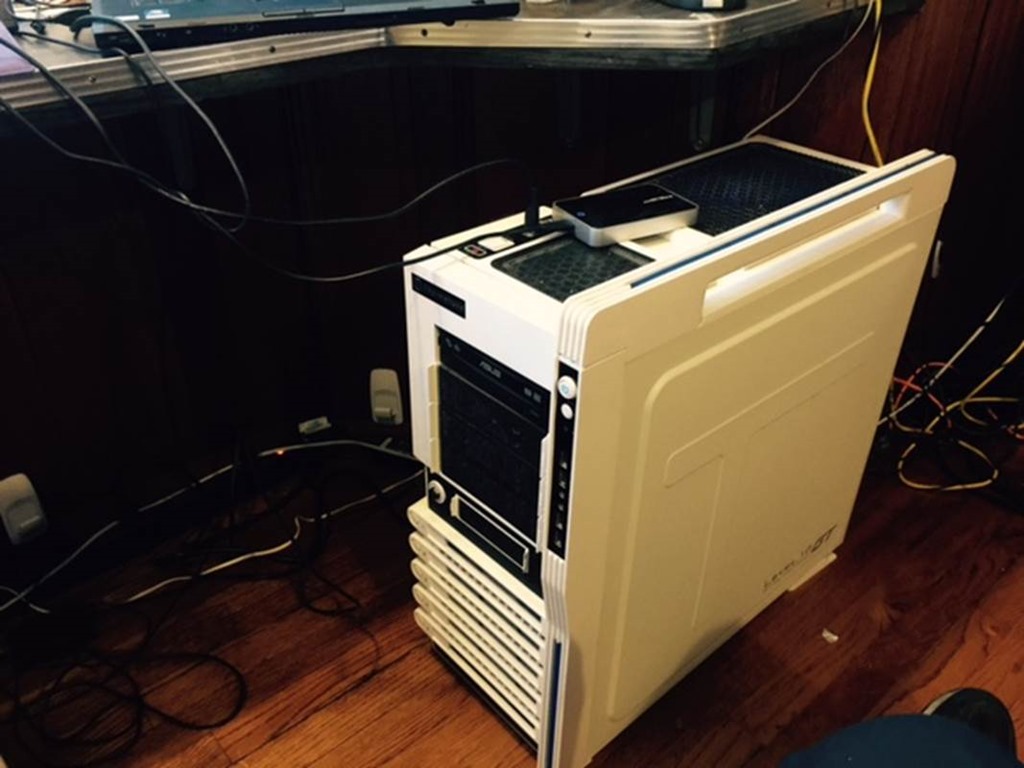
Got home to find the ThinkPad couldn’t update and failed to boot, would I like it to attempt to restore? Never did that before, but what the hell. Told it yes. Then got out of my chair and onto my knees and was able to put Alien Artifact’s front panel back on without problems.
clip_image002

Alien Artifact with his front cover back on properly. Was easy once I could get at it.

ThinkPad trundled a while and restored Windows 7 fine, and seems none the worse for wear; he is a little ancient and may need replacing but I’m hoping the Surface Pro 3 will do take his place. The Surface has larger keys and easier to type on, but the screen is smaller; and it’s been devoted to alpha versions of Windows 10; but that experiment is about over. Precious, the Surface Pro, seems stable now, and I’ll start to putting her to good use. Or try to.
clip_image004

clip_image006

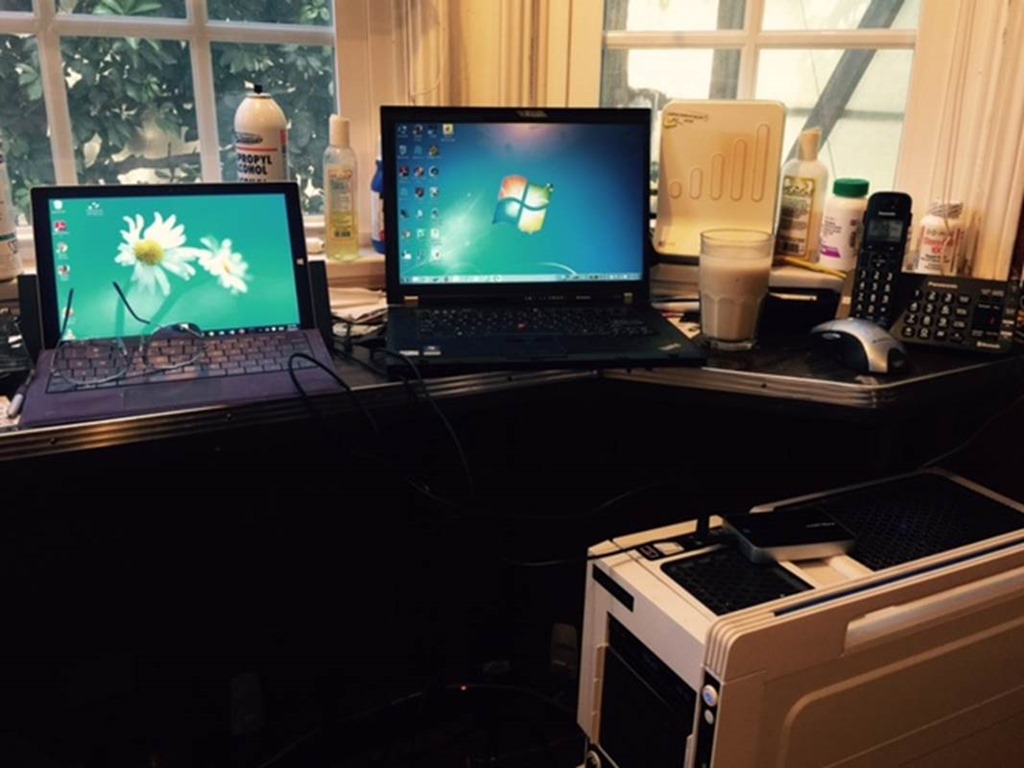
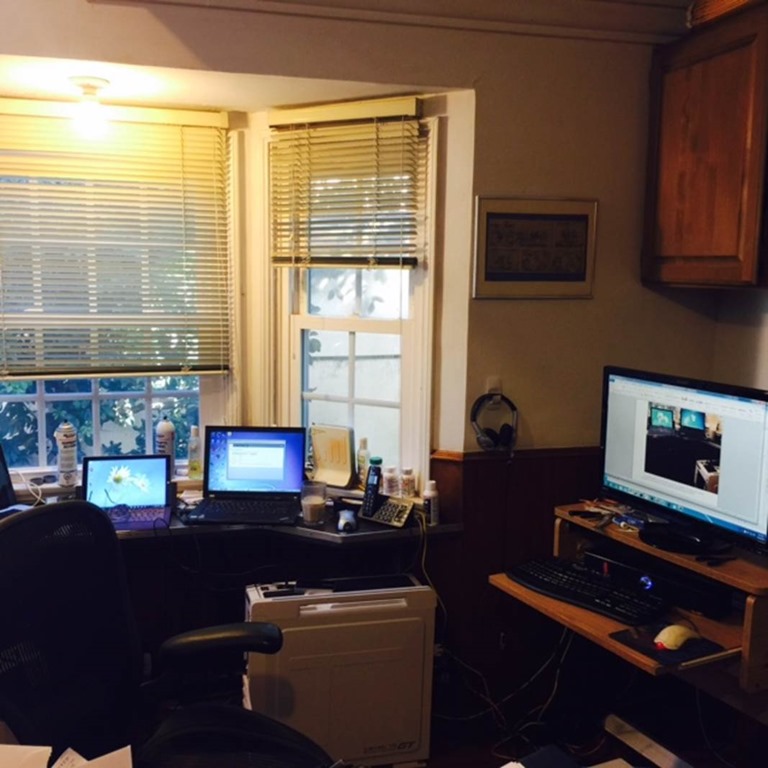
The cramped quarters I now live in; they won’t let me work upstairs in the grand office. But we wrote Mote in God’s Eye here, on a Selectric typewriter, and Zeke lived here all his life

This weekend I hope to get Alex and Eric over to bring down Swan and get her set up in the back room and we’ll worry about synchronizing Outlook; my agent sent reasonable royalties for May, so I can afford a good office chair, probably a duplicate of the Henry Miller I’m in now, and keep it in the back room in place of the wheel chair which can go to someone who needs it; and the ThinkPad popped up with “Threat Warnings” but Norton said it could fix them; turns out I haven’t used it much and Windows Security Essentials wasn’t happy either, so I’m doing all the scanning anybody wants, smoothly and without problems.

And I typed all this, two fingers, but I got several whole sentences without errors – some of that is that I have trained autocorrect to find lots of words with numbers in them where I hit two keys at once, but also I’m not hitting two keys at once so much either. I got nit for not in that last sentence, and ion for in in this one, but fortunately I found those.

So, after many adventures, it has been a good day after all. When I get back from my LASFS meeting tonight I will have Precious in the back room and see if I can add anything to this, but any mail I’ll have to put in from here, where I won’t get until tomorrow. But for a day which looked like disaster, it turned out well.

bubbles

bubbles

The 97% consensus of climate scientists is only 47%.

<http://fabiusmaximus.com/2015/07/29/new-study-undercuts-ipcc-keynote-finding-87796/>

Also, note that the survey questions were biased – there wasn’t any option for disputing the statements, only ‘I don’t know’ or ‘Other’.

—————————————

Roland Dobbins

I remain of the opinion that we have insufficient data; but Bayesian analysis would indicate spending more on data than on amelioration of either coming warm or coming cold age. Reduction of uncertainties will save money; preparations before uncertainty reduction is expensive. Do we buy blankets or bathing suits?

And there are repeated stories like this:

Mind-Blowing Temperature Fraud At NOAA.

‘Almost half of all reported US temperature data is now fake. They fill in missing rural data with urban data to create the appearance of non-existent US warming.’

<https://stevengoddard.wordpress.com/2015/07/27/mind-blowing-temperature-fraud-at-noaa/>

—————————————

Roland Dobbins

Mostly the Iron Law at work. 

bubbles

Quote from Madison

Jerry,

I think this quote from Madison is quite apropos for today:

“A popular Government, without popular information, or the means of acquiring it, is but a Prologue to a Farce or a Tragedy; or, perhaps both. Knowledge will forever govern ignorance: And a people who mean to be their own Governors, must arm themselves with the power which knowledge gives.”

— James Madison to W. T. Barry, Aug 4, 1822, James Madison, The Writings of James Madison, vol. 9 (Correspondence, 1819-1836) [1910] <http://oll.libertyfund.org/people/james-madison>

Some days I think we are now in the Farce and Tragedy.  But as you remind, despair is a sin.

Regards,

Charles Adams, Bellevue, NE

bubbles

The joys of ‘smart’ rifles.

<http://www.wired.com/2015/07/hackers-can-disable-sniper-rifleor-change-target/>

—————————————

Roland Dobbins

bubbles

: Massive Surveillance Crisis

I can’t find the words to describe this shocking development other than to say this is both disgusting and monumental:

<.>

CISA is an out and out surveillance bill masquerading as a cybersecurity bill. It won’t stop hackers. Instead, it essentially legalizes all forms of government and corporate spying.

Here’s how it works. Companies would be given new authority to monitor their users — on their own systems as well as those of any other entity — and then, in order to get immunity from virtually all existing surveillance laws, they would be encouraged to share vaguely defined “cyber threat indicators” with the government. This could be anything from email content, to passwords, IP addresses, or personal information associated with an account. The language of the bill is written to encourage companies to share liberally and include as many personal details as possible.

That information could then be used to further exploit a loophole in surveillance laws that gives the government legal authority for their holy grail — “upstream” collection of domestic data directly from the cables and switches that make up the Internet.

Thanks to Edwards Snowden, we know that the NSA, FBI, and CIA have already been conducting this type of upstream surveillance on suspected hackers. CISA would give the government tons of new domestic cyber threat indicators to use for their upstream collection of information that passes over the Internet. This means they will be gathering not just data on the alleged threat, but also all of the sensitive data that may have been hacked as part of the threat. So if someone hacks all of Gmail, the hacker doesn’t just get those emails, so does the U.S. government.

The information they gather, including all the hacked data and any incidental information that happens to get swept up in the process, would be added to massive databases on people in the U.S. and all over the world that the FBI, CIA, and NSA are free to query at their leisure. This is how CISA would create a huge expansion of the “backdoor” search capabilities that the government uses to skirt the 4th Amendment and spy on Internet users without warrants and with virtually no oversight.

</>

http://thehill.com/blogs/congress-blog/technology/249521-cisa-the-dirty-deal-between-google-and-the-nsa-that-no-one-is

Once we start looking at counterintelligence programs, false flag operations, and so on, things get even more interesting….

◊ ◊ ◊ ◊ ◊

Most Respectfully,

Joshua Jordan, KSC

Percussa Resurgo

bubbles

Krebs on Security has posted a new item.
Starting today, Microsoft is offering most Windows 7 and Windows 8 users a free
upgrade to the software giant’s latest operating system — Windows 10. But
there’s a very important security caveat that users should know about before
transitioning to the new OS: Unless you opt out, Windows 10 will by default
share your Wi-Fi network password with any contacts you may have listed in
Outlook and Skype — and, with an opt-in, your Facebook friends!
http://krebsonsecurity.com/2015/07/windows-10-shares-your-wi-fi-with-contacts/

I have numerous comments from informed sources; the consensus seems to be that all the default options are opt in; but you should be aware of them.

Windows 10 Shares Your Wi-Fi With Contacts

In spite of the hysteria, I believe it is already fully opt-in.

The only, only, only thing that defaults to “on” is that the service is enabled. Every time a user adds a new Wi-Fi network, the dialog box specifically asks whether to share it with contacts or not, and which contacts to share it with from the three available options (Outlook/Facebook/Skype). All four of those questions, at least on my machine with a clean install, defaulted to OFF.

If the service itself is turned off, none of those sharing questions will be asked.

Now, if someone has turned on the service and shared a network, maybe it defaults to enable sharing the next time; I didn’t test that.

I think this business Krebs raises (and the Register raised) about how a friend could share your Wi-Fi credentials without your permission is just nonsense. That still takes a deliberate effort. If you have a friend who would do that, you need new friends.

bubbles

Rare outbreak of sanity

http://www.zdnet.com/article/no-windows-10s-wi-fi-sense-feature-is-not-a-security-risk/?tag=nl.e539&s_cid=e539&ttag=e539&ftag=TRE17cfd61

Eric

bubbles

bubbles

Freedom is not free. Free men are not equal. Equal men are not free.

bubbles

clip_image008

bubbles

EM Drive Real? Microsoft New Policy: Beware? Lion Murderers and Free Markets

Chaos Manor View, Wednesday, July 29, 2011

“the use of even one nuclear bomb inside Israel will destroy everything. However, it will only harm the Islamic world. It is not irrational to contemplate such an eventuality,”

former Iran President Hashemi Rafsanjani

bubbles

It is Wednesday morning and Niven and Barnes are coming, so this will mostly be a placeholder; but we have important announcements. My partners are waiting so I must go.

bubbles

Microsoft’s new ‘privacy’ policy.

from

<https://edri.org/microsofts-new-small-print-how-your-personal-data-abused/>

“We will access, disclose and preserve personal data, including your content (such as the content of your emails, other private communications or files in private folders), when we have a good faith belief that doing so is necessary to”, for example, “protect their customers” or “enforce the terms governing the use of the services”.

It seems pretty clear that people who harbor controversial views should probably give Windows 10 a pass. Else the Social Justice Warriors who’re rife in large corporations like Microsoft will report them to the relevant authorities for public shaming and attitude adjustment.

And of course, there’s no risk that this information would ever be compromised by, say, hackers and sold to the highest bidder. None whatsoever.

How comfortable are you now writing your new novel manuscript on Windows 10, sir?

—————————————

Roland Dobbins

Not very, but fortunately I don’t have anything on Windows 10 machines that isn’t open. It is disturbing. All your thoughts are belong to me…

bubbles

EmDrive

(clip from UK Telegraph story)
…this week Martin Tajmar, a professor and chair for Space Systems at Dresden University of Technology in Germany also showed that it produces thrust.

The drive is capable of producing thrust several thousand times greater than a standard photon rocket and could get to Mars within 70 days or Pluto within 18 months. A trip to Alpha Centauri, which would take tens of thousands of years to reach right now, could be reached in just 100 years.

“Our test campaign cannot confirm or refute the claims of the EM Drive but intends to independently assess possible side-effects in the measurements methods used so far,” said Prof Tajmar in an interview.

“Nevertheless, we do observe thrust close to the actual predictions after eliminating many possible error sources that should warrant further investigation into the phenomena.”

Full article here:
http://www.telegraph.co.uk/news/science/space/11769030/Impossible-rocket-drive-works-and-could-get-to-Moon-in-four-hours.html

The point that I haven’t seen reported on, is that this is a first iteration of the design.  A proof of concept.  Think of the meager capabilities of the first working gasoline engine, and then compare that to the engine under the hood of your car… or the diesel engines that power heavy construction equipment.  Compare the Wright Flyer to a Boeing 787.

There is tremendous opportunity for improvement here.  We may be standing on the verge of a change so fundamental, as to be difficult to fully comprehend.

Regards, Charlie

This is from a less volatile source than previous stories were, but we still don’t know that “It works.” Extraordinary claims require extraordinary proof. Obviously this would be a game changer if it’s real. We can hope. If real it’s the key to the solar system.

And this:

EM drive yet again

Jerry,

Yet another article about the EM drive.

http://www.telegraph.co.uk/news/science/space/11769030/Impossible-rocket-drive-works-and-could-get-to-Moon-in-four-hours.html

This time, they’re basically saying they’ve thought really hard about what side effects might be causing false results, but after eliminating those effects they still see thrust being generated. The final speculation is that there is an unknown interaction with subatomic particles that constantly transfer state from matter to energy and back again.

So basically we have a drive that relies on the aether, but this time its a practical and measurable effect of a theory about mass-energy equivalency that we didn’t really think was useful except or visible except on the event horizon of a black hole (Hawking radiation). At least that’s what it sounds like they’re talking about, from the perspective of someone who read some of Hawking’s easier books 20 yrs. ago. Still, wouldn’t that be neat, creating an energy or propulsion source out of hawking radiation without needing a captive black hole, and all you need is a bit of electricity to make it work?

Sean

I agree that if you reject relativity and embrace an aether theory, Newtonian mechanics can be saved; all the crucial experiments against aether I know of can be explained by the local aether field being entailed by planetary mass and a finite speed of propagation of gravity (probably but not absolutely necessarily the speed of light, which might in fact vary with local gravity field strength);  even with variable speed of light the equations appear to be simpler than relativity tensors. If the EM drive actually produces thrust it is the most important physics discovery of the 21st – and likely of the 20th centuries.  But that is still a big if.  We have reason to do more confirming experiments now; and if there really is thrust, the results are profound – so profound that we cannot assume that thrust without more evidence. Apparently the next tests are not prohibitively expensive.

Petr Beckmann would not have been astonished by the EM drive; Robert Forward would have been, but not overwhelmed. But it is not the Relativity universe any longer, and much of what is studied in advanced theoretical physics would be proved wrong.

But we are still entitled to doubts about the thrust.

Make no mistake: if the EM works, the world changes.

bubbles

http://www.wsj.com/articles/israels-choice-conventional-war-now-or-nuclear-war-later-1438125451

Israel’s Choice: Conventional War Now, or Nuclear War Later

By

Norman Podhoretz

Almost everyone who opposes the deal President Obama has struck with Iran hotly contests his relentless insistence that the only alternative to it is war. No, they claim, there is another alternative, and that is “a better deal.”

To which Mr. Obama responds that Iran would never agree to the terms his critics imagine could be imposed. These terms would include the toughening rather than the lifting of sanctions; “anytime, anywhere” nuclear-plant inspections instead of the easily evaded ones to which he has agreed; the elimination rather than the freezing of Iran’s nuclear infrastructure; and the corresponding elimination of the “sunset” clause that leaves Iran free after 10 years to build as many nuclear weapons as it wishes.

Since I too consider Mr. Obama’s deal a calamity, I would be happy to add my voice to the critical chorus. Indeed, I agree wholeheartedly with the critics that, far from “cutting off any pathway Iran could take to develop a nuclear weapon,” as he claims, the deal actually offers Tehran not one but two paths to acquiring the bomb. Iran can either cheat or simply wait for the sunset clause to kick in, while proceeding more or less legally to prepare for that glorious day. <snip>

It is all worth reading; and the logic is powerful. Mr. Obama assuages Israeli dismay with the irrelevant coming release of Pollard. There is nothing about the rationality of irrationality.

bubbles

bubbles

bubbles

Lion Murderer Walt Palmer Has Done More For Conservation Than You Have.

[Warning: ‘adult language’.]

<http://indefinitelywild.gizmodo.com/lion-murderer-walt-palmer-has-done-more-for-conservatio-1720901473>

—————————————

Roland Dobbins

What you call adult language I would call childish, but it is certainly needlessly scatological; that is mostly in the comments, of course.

I don’t type well any longer, so I am conserving that energy for fiction this week; but this presents the free trade argument for animal preservation fairly well.

I have never been much of a large animal hunter, but in WWII I certainly supplemented the family meat pot with rabbits unfortunate enough to encounter me and my gazehound Spitz dog. Farms had enough butter, eggs, milk, and cheese, but meat was scarce because we needed the butter, eggs, milk, and cheese…  The arguments against a free market in endangered animals are generally emotional; the results have universally been an increase in the number of endangered individuals. Tearing the ivory keys off old pianos does little to preserve living elephants, although hunting them down benefits the bureaucrats who are paid to do it.  It may be an unpleasant thought, but a free market in Ivory would likely result in more elephants, and more mercenaries paid to guard them.  It would also generate quite disturbing stories, many true, and a lot of adult language.  The issues are seldom discussed rationally; hence the scatology.

bubbles

This was priceless

Pretty good, check it out about 40 seconds in

#Top5 Pesky Monkeys | JukinVideo Top Five

image

#Top5 Pesky Monkeys | JukinVideo Top Five

B


bubbles

bubbles

bubbles

Freedom is not free. Free men are not equal. Equal men are not free.

bubbles

clip_image002

bubbles

More Educating the Starborn; and other matters.

Chaos Manor View, Monday, July 27, 2015

bubbles

I’m still working on fiction, and although it wasn’t in the plot we conceived for our new novel, the education system for an interstellar colony in a slower than light travel universe turns out to take a lot of work; even though you’ll see little of it in the finished product.

We have a population of a few aging adults who were born on Earth but will never see it again. Most were asleep for the whole trip.

The rest are Starborn: either conceived on their destination colony, or on earth to travel as frozen embryos and be born on the colony. There are more of them than of adults, but they are growing up.

Science and technology are no problems; but culture and literature? History? The history we know was of a place they will never see. The only literature is of a place they will never visit. Their only literature was written a century before they were born on a place 14 lightyears away.

Shakespeare. Romeo and Juliet, King Lear, Macbeth. Hamlet? Of course all the works are available; most of the works of mankind are available. We teach only one culture, which is roughly Americanism as seen by the Framers, and we need to teach some history to go with that.

Racial equality is a fact: at least in intelligence, health, these are descendants of the best we have without regard to race or color.

Consent of the governed.

But I ramble, and it’s late.

bubbles

The news is sufficiently depressing that I remind myself often that despair is a sin, and it’s really early days before 2016. The one guy getting attention is Trump. The Republican establishment seems bent on finding someone Hillary can beat – hard to do – but then they found Bob Dole, the only guy Bill Clinton could beat, to run in ’96. They are really working to repeat that triumph. Maybe – no. I won’t speculate.

bubbles

Educating the Starborn

Jerry,
Answering your question is a complex issue. It seems you have two problems to solve — developing and inculcating a culture that makes sense on Avalon while also maintaining identity with the people of Earth. The former is important because the purpose of culture is to provide a common framework for survival and growth in a given environment. The latter is important lest Earth’s first colony eventually becomes Earth’s worst enemy. Of course, since there is no bidirectional travel between Avalon and Earth for the foreseeable future, evolution will ensure species divergence between Avalon and Earth. When bidirectional travel does become possible, the two populations may not have much in common physically or culturally.
So who are the people of Avalon and what do they wish to become? They came from the stars; will they be happy with just one planet or do they wish to continue the diaspora? Will they see value in colonizing the entire Avalon system, or will they be happy to pound dirt? These kinds of questions beg answers that inform about culture. That should then inform about education.
You do not ask about HOW the star-born are to be educated. What should an Avalon school look like? How should it operate? How will education be measured? This is an opportunity to provide a glimpse into an idealized educational setting…
No answers, but perhaps food for thought.

Kevin L Keegan

You save me a lot of typing by asking some of the questions I am dealing with. Of course this novel is not about an education system; but we need to know much of that before we can start.

bubbles

What the Starborn should know

Dr. Pournelle,
I’ve been thinking about your posts on starborn education while reading “There will be war” III and IV. I assume that you are working in the Avalon universe, but I cannot remember the complete “historical” background for the stories. From your responses to other correspondents, I think that you are more concerned with curriculum than mechanics, format, class(room) sizes, or learning environment.
I’ve been speculating on the kind of multi-year course I could design on social/government theory and politics using 19-21st century science fiction. Perhaps selecting a theme (e.g. “Mars”) one could probably create a complete master’s level course — an incomplete list might include comparisons between Wells, Heinlein, Arthur Clarke, Bradbury, Burroughs, Niven, Kim Stanley Robinson, and Andy Weir along side actual historical and scientific observation and exploration in the authors’ contemporary context. Or course work on ethics and technology could include Shelley, Swift, Capek, Asimov, Clarke, Heinlein, Wells, Orwell, Crichton, Kipling, P. K. Dick, Spider (the other) Robinson.
In other words, given the chance, I’d design a curriculum the same way you’ve developed anthologies — pick a theme that illustrates the desired lesson, and pull in the last two centuries’ worth of fiction for allegory, example, and analysis. I’d provide editorial comment to support the analysis. I’d extend the lists above to other media — Orson Orson Welles, Fritz Lang (perhaps even Walter Lang), George Lucas, Rod Serling, even Stan Lee.
I think that the Avalonians have some history in common with us now, in “real” life, as well as some idea of politics, sociology, philosophy. It seems as if the parents would design their teaching to follow those ideas and themes. I don’t see how or why they’d be constrained to choose from the literature and entertainment available to our parents’s teachers.
If I am correct and you are working on an Avalon collaboration, modesty (or suspension of disbelief?) may prevent you, Niven, or Barnes from including your own real world works in starborn course work, but I’m sure the Universe’s “book” and your combined critical reading and insight can determine what the starborns’ parents want them to know as well as how to provide it to them.
IMO the short answer to your question “what would they have read?” should begin with at least Clarke, Heinlein, and Asimov.
-d

bubbles

Educating the Starborn

Dear Dr. Pournelle,
Great topic. Couple thoughts:
I’m thinking technology training won’t be a problem for a few generations at least, since it’s unlikely that a huge portion of any interstellar colonists won’t be high-end tech geeks. If mom and dad spend their days laying Hobartium cables along the colony’s perimeter to power the Repulsor Array, and are recognized and honored for their labors, enough little Janes and Johnnies will want to follow suit – and will have the environmental (and genetic!) prerequisites to do so.
Establishing and maintaining a civilization, on the other hand, will be a HUGE challenge and problem. The at-rest state for human culture is barbarism and tyranny. Republican Democracy, with human rights and the outrageous notion that the wisdom of the nation lies in its people, not its leaders, is terribly anti-entropic: Falling into barbarism is as easy as falling down. That’s why Harry M’s comments about the necessity of storytelling is the right idea.
Putting the above together: the Geeks will assume they are the smart ones, and therefore naturally ought to be in charge. And, in fact, when the major pressing problems are all engineering problems, they may even be right. People being people, they will get used to the idea that the engineers ought to be in charge – less work for them, and the oxygen keeps coming and the lights are on, after all. Pournelle’s Law will quickly kick in, and the geeks who like power will get it. And then the colonists are oh so screwed. (If you’ve ever worked in a company where the Geeks are in charge, you’ve seen a minor vision of how this will work out. Just imagine throwing adulation and real power into the mix. Gasoline on an open flame)
One nice side effect of needing to have lots of engineers: I would expect graded classroom education to die the death it has long deserved, as the ‘luxury’ of warehousing kids for a decade or more for their parents convenience will not be affordable – you need the talent in the field. I’d expect apprenticeships at a young age, with something like guild training, to accompany the storytelling so essential to civilization.
One last amusing thought: resource allocation will be the underlying challenge for just about every colonial project. Could it be that boring finance types like myself would be needed in space, to do the cost/benefit analysis from a more general perspective? Heck, you might even need some internal marketing types to make sure the message gets out correctly. And the geeks will have to listen to those people! Space just might turn out to be like working in the Valley. Thus, even for geeks in space, wherever you go, you bring your hell with you…
Regards,
Joseph Moore

We certainly will not have traditional high schools; we probably will have fairly traditional early grades; because learning some self discipline is important. And the Earthborn are certainly aware that the women are strong, the boys are good looking, and all the children are above average. And we do have tools for systems analysis, and no credentialing bureaucracies, at least not yet. But don’t forget the Iron Law.

bubbles

Jerry,

Not an analysis per se, but a clarifying thought:

What is the risk to the Starborn of “studying war no more?”

A ship of pacifists who never learn the meaning of interpersonal conflict will have neither the emotional constitution or the cognitive ability to deal with warfare if it becomes necessary – and may be hampered even with dealing with less personal crises.  Or the occasional headstrong individual.

Conversely, a ship of warriors will undoubtedly find internal conflict leading to casus belli which may compromise the mission.  (cf. Orphans of the Sky.)

In the final analysis, I come back to Terence, as I usually do:

Homo sum, humani nihil a me alienum puto.

Teach them everything.  And give them the United States Constitution and the Bill of Rights – the no loopholes version, with notes on how even those venerable documents are subject to social decay – as their guides to self-governance

Jim Woosley

They learned in the first book that there are monsters. And yes, I think the Framers and their logic are essential.

bubbles

The Iron Rule writ large? —

Dr. P,

This would seem to take the cake for a bureaucratic cover-up. I apologize for the lengthiness of the excerpts, but it is too complex to fit in a sound bite:

Missed Calls

Is the NSA lying about its failure to prevent 9/11?

By James Bamford.

July 21, 2015

On March 20, 2000, as part of a trip to South Asia, U.S. President Bill Clinton was scheduled to land his helicopter in the desperately poor village of Joypura, Bangladesh, and speak to locals under a 150-year-old banyan tree. At the last minute, though, the visit was canceled; U.S. intelligence agencies had discovered an assassination plot. In a lengthy email, London-based members of the International Islamic Front for Jihad Against Jews and Crusaders, a terrorist group established by Osama bin Laden, urged al Qaeda supporters to “Send Clinton Back in a Coffin” by firing a shoulder-launched missile at the president’s chopper.

The same day that Clinton was supposed to visit Joypura, the phone rang at bin Laden’s operations center in Sanaa, Yemen. To counterterrorism specialists at the National Security Agency (NSA) in Fort Meade, Maryland, the Yemeni number—967-1-200-578—was at the pinnacle of their target list. They monitored the line 24/7. But at the time, the agency now claims, it had no technical way of knowing who was placing the call. The culprit, it would later be revealed, was Khalid al-Mihdhar, one of the men bin Laden had picked months earlier to lead the forthcoming 9/11 attacks. He was calling from his apartment in San Diego, California.

The NSA knew about Mihdhar’s connection to bin Laden and had earlier linked his name with the operations center. Had they known he was now reaching out to bin Laden’s switchboard from a U.S. number, on the day an al Qaeda-linked assassination plot was planned, the agency could have legally obtained an order to tap the San Diego phone line. The Foreign Intelligence Surveillance Court, in fact, approves eavesdropping on suspected terrorists and spies in the United States. By monitoring Mihdhar’s domestic calls, the agency certainly would have discovered links to the 9/11 hijackers living on the East Coast, including Mohamed Atta.

It’s likely, in other words, that 9/11 would have been stopped in its tracks.

A decade and a half later, that call and half a dozen others made from the San Diego apartment are at the center of the heated debate over the NSA’s domestic surveillance activities—namely the agency’s collection of the public’s telephone metadata, which George W. Bush’s and Barack Obama’s administrations have claimed was authorized by the 2001 Patriot Act. (That law expired this June and was replaced with the USA Freedom Act, which states that, without a warrant from the Foreign Intelligence Surveillance Court, the NSA will no longer have access to telephone metadata records.)

According to Michael Hayden, the NSA’s director from 1999 to 2005, the failure to realize that the man phoning Sanaa was located in San Diego was evidence that mass surveillance is vital to U.S. national security. “Nothing in the physics of the intercept, nothing in the content of the call, told us they were in San Diego,” Hayden told Frontline in 2014. “If we’d had the metadata program … those numbers in San Diego would have popped up.”

….

After 9/11, Thomas Drake, a member of the NSA’s Senior Executive Service, was assigned to provide an overview of what the agency knew at the time of the attacks to a Senate subcommittee during a closed-door hearing. In his research, Drake discovered the transcripts of the calls from Mihdhar to the Sanaa operations center. “We essentially had cast-iron coverage on that safe house at least since 1996.… People don’t realize how much NSA actually knew about the network,”…

When Drake heard Hayden’s denial that the NSA had the technical capability to determine that Mihdhar was calling from San Diego, he completely disagreed. “Not true. That’s an absolute lie,” he said. “Every number that comes into that switchboard, if you’re cast-iron coverage on that switchboard, you know exactly what that number is and where it comes from.… You know exactly—otherwise it can’t get there.”

Another problem, according to Drake, was that before the 9/11 attacks, the NSA didn’t share what it knew with other federal intelligence agencies—and it has sought to cover up its negligence after the fact. Drake put this in his report for the subcommittee, he said, but the document was rejected by his boss at the NSA, who subsequently removed him from the hearing’s roster of participants.

<http://foreignpolicy.com/2015/07/21/missed-calls-nsa-terrorism-osama-bin-laden-mihdhar/>

      Regards,
      Bill Clardy
“Excellence is doing ordinary things extraordinarily well.” — John Gardner

bubbles

Overpriced and Underperforming F-35
Good morning, Dr. Pournelle,
I saw this article via Ace of Spades, and thought you might find it interesting: http://www.nationalreview.com/article/421473/f-35-defense-waste-danger
Personally, I think that the real reason for this Dodo is to enrich the vendor, who hires a lot of ex-military types after they retire. Everyone wins except the people who may have to fly and maintain this junker, and the taxpayer.
Regards, and my wife and I are praying for your continued recovery.
Don Parker

bubbles

Travesty in Education

I hope this does not become a pattern:

<.>

Virginia Tech is reportedly requiring professors seeking tenure to pass a sort of litmus test when it comes to “diversity” and “inclusion.”

When it comes to applying to for tenure at many universities, scholars academic work and teaching are usually what falls under the microscope. This is no longer the case at Virginia Polytechnic Institute and State University (Virginia Tech), which recently released new promotion and tenure guidelines.

</>

http://www.campusreform.org/?ID=6688

◊ ◊ ◊ ◊ ◊

Most Respectfully,

Joshua Jordan, KSC

Percussa Resurgo

Over the past twenty years the universities have become very much alike. The Iron Law at work.

bubbles

http://www.eetimes.com/document.asp?doc_id=1327251

90+GHz Photonic Emitters On-chip (EE Times)

Nanopatch plasmonic antennas beat lasers

R. Colin Johnson

7/27/2015 05:00 AM EDT

PORTLAND, Ore. — Forget trying to integrate lasers on silicon chips for optical computing; instead use nanopatch plasmonic antennas (NPAs) for emission of telecommunications infrared signals at speeds up to 90 GHz now and maybe terahertz tomorrow.

“We want to speed-up in emission rate to build an ultrafast and super-bright light emitting diode,” said Duke University Assistant Professor Maiken Mikkelsen. “This will involve using conducting materials to bring electrical current to the quantum dots to create enhanced emission from same plasmonic structure.” “Such a device has the potential to operate at very low power levels — at a few attojoules — which is critical to transform future information processing and communications, currently limited by heat dissipation,” said Mikkelsen.

The whole semiconductor industry has been trying to convert from electrons to photons as the signal medium for computing on silicon chips. Every kind of silicon photonic devices have been demonstrated, except the emitters. Unfortunately, lasers — the standard communications emitter — are incompatible with silicon, though a thousand methods are being researched to solve that problem. Now Duke University electrical engineers say forget lasers, but instead use their NPAs coupled to quantum dots to communicate 90-GHz and up on-chip or between them at a radiative quantum efficiency of over 50%.

“Typical emitters such as molecules, quantum dots and semiconductor quantum wells have slow spontaneous emission with lifetimes of 1–10 nanoseconds, creating a mismatch with high-speed nanoscale optoelectronic devices such as light-emitting diodes, single-photon sources and lasers. Here we experimentally demonstrate an ultrafast (<11 pico-seconds) yet efficient source of spontaneous emission, corresponding to an emission rate exceeding 90 GHz,” Maiken Mikkelsen’s group at Duke say in the introduction to Ultrafast spontaneous emission source using plasmonic nano-antennas.

To achieve their high-speed switching rate, the researchers use plasmons (free electrons on a surface that oscillate together in a wave) as nano-antennas consisting of silver nanocubes coupled to a thin gold film (20 atoms thin) separated from the substrate by a thin polymer spacer layer with a colloidal core of shell quantum dots. This structure increases the spontaneous emission rate by 880-times while simultaneously enhancing the fluorescence intensity by 2300-times while maintaining a high efficiency.

“We have demonstrated an ultrafast spontaneous emission source with an emission speed exceeding 11 ps from a hybrid system consisting of plasmonic nano-antennas coupled to ensembles of colloidal quantum dots,” Mikkelsen and colleagues say in their research paper.

As a extra bonus, the frequency of emission can be tuned to the precise telecommunications frequencies in use today by controlling the dimensions of the nano-cubes and the gap thickness of the insulating dielectric. Plus NPAs coupled to their quantum dots are much lower energy in operation than lasers, allowing photonic chips to run cooler and mobile devices to have longer battery life.

For the future, the researchers want to excite the plasmonic nanoantennas (which for the proof-of-concept demonstration used lasers) both optically and electrically so as to enable both the methods to thereby solve the last remaining obstacles to integrating photonics with traditional electronics. The team also hopes to more precisely place the quantum dots so as to boost the fluorescence rates to closer to the terahertz range.

Funding was provided by the Air Force Office of Scientific Research Young Investigator Program, the Air Force Office of Scientific Research, Oak Ridge Associated University’s Ralph E. Powe Junior Faculty Enhancement Award, the Lord Foundation of North Carolina, and the Intelligence Community Postdoctoral Research Fellowship Program.

Get all the details in Ultrafast spontaneous emission source using plasmonic nano-antennas published in Nature Communications (under 6:7788 | DOI: 10.1038).

— R. Colin Johnson, Advanced Technology Editor, EE Times

bubbles

bubbles

bubbles

bubbles

Freedom is not free. Free men are not equal. Equal men are not free.

bubbles

clip_image002

bubbles

Educating the Starborn

Chaos Manor View, Sunday, July 26, 2015

It’s Sunday night, and I’m still in fiction mode. This is short shrift…

bubbles

bubbles

Educating the Starborn

Dear Jerry:
In your View for 7/23/2015 ( https://www.jerrypournelle.com/chaosmanor/education-of-the-starborn/) you wrote:

I have been worrying about education: what is the curriculum for children on an interstellar colony? There must be some common culture, and it won’t all be science and technology.

Would the answer not depend on what kind of common culture you want to establish among the starborn?
I immediately thought of Dr. John Patrick’s comments about children and stories. Recall from my previous e-mails that Dr. Patrick is a pediatrician and a founder and president of Augustine College in Ottawa.
http://www.johnpatrick.ca/
http://www.augustinecollege.org/

Dr. Patrick tells how children love hearing stories repeated over and over because the stories inform the child about his place in the world.
At one time in western civilization the most widely known stories were from the Holy Bible. Every one of those stories was about moral consequence. People were so familiar with those stories that it is said that the miracle of Dunkirk was launched by a three-word message from a British officer trapped on the beach: “But if not”.
(See George Will’s “A Dying Tradition” at
https://news.google.com/newspapers?nid=1915&dat=19840504&id=CwsiAAAAIBAJ&sjid=23IFAAAAIBAJ&pg=1892,764718&hl=en
or Will’s more recent “Closing the book on literature” at
http://www.jewishworldreview.com/cols/will072204.asp
More recently in America the most widely known stories come from television advertising, stories with no moral consequence in which the most frequently taught lesson is “Just do it!” This week we have seen one result of that teaching. We have watched videos of highly-schooled physicians negotiating the selling prices for the brains and hearts and livers of human beings who were dissected as living babies in their mother’s wombs.
As Arthur Leff wrote in “Unspeakable Ethics, Unnatural Law”, “As things now stand, everything is up for grabs.”
(Duke Law Journal, Vol. 1979, No. 6, pp. 1229-1249 (December 1979). Available as a PDF file from http://scholarship.law.duke.edu/dlj/vol28/iss6/1
Dr. Patrick points out that the Jews have survived for more than 2,000 years without a homeland and are still identifiable as Jews. That is a miracle. If you took a bunch of Americans to an isolated desert island, for how many years would they remain Americans? The reason for the Jews’ survival can be found in Deuteronomy 6, where parents are instructed by Moses to tell their story to their children:

In the future, when your son asks you, “What is the meaning of the stipulations, decrees and laws the Lord our God has commanded you?” tell him: “We were slaves of Pharaoh in Egypt, but the Lord brought us out of Egypt with a mighty hand.

In other words, tell the children the stories, and tell them over and over again:

Impress them on your children. Talk about them when you sit at home and when you walk along the road, when you lie down and when you get up. Tie them as symbols on your hands and bind them on your foreheads. Write them on the doorframes of your houses and on your gates.

One place Dr. Patrick discusses this is in his lecture “Why Ethics Courses Do Not Make Us Ethical.”
(A recording can be found at http://mcophilly.org/resources/audio-files/ethics-courses-do-not-make-us-ethical/ )
What kind of sustainable common culture do you want for your starborn? Will they have a high view of humankind? Or will they have a diminished view of what it means to be human in which their fellow humans are no more than meat to be used by others.
Best regards,
–Harry M.

You have raised some of the questions that concern me; I can’t really comment, but I hope to address them in the book

bubbles

RE: Educating the Star Born

You asked: “I have been worrying about education: what is the curriculum for children on an interstellar colony? There must be some common culture, and it won’t all be science and technology. Sure, as time goes on, there will be those who choose to specialize, “Classicists”, Shakespearian experts, and so forth; but, besides Dr. Seuss, what books have all the kids read? And whose history?”

E.D. Hirsch Jr.’s What Your [K-6th] Grader Should Know series might be a good place to start.  It may be too USA specific but the series is based on his concept of Cultural Literacy or a common knowledge base for educated people.

After that perhaps the Harvard Classics and Fiction instead of Britannica’s Great Books. Your own suggestions on history and math plus one or two ‘foreign’ languages after all if the Swiss can have 3 official languages why not our Star Born?

Thanks for keeping us informed,

Paul Evans

bubbles

educating the starborn

Dear Mr. Pournelle,
You ask “what books have all the kids read? And whose history?” A fascinating question. What I’m wondering is, how might we avoid a dystopian answer?
On the assumption that “everything” (or near enough) is available electronically, there will be easily enough available for multiple intellectual universes. We already do that: interesting studies have found that politically-literate readers in the United States tend to cluster in two groups, one of which would never read Ann Coulter and the other would never read Michael Moore. Both are convinced the other group has nothing worth considering.
So: given the easy availability of “everything,” how do we avoid smug echo chambers? Alexei Panshin once wrote of our desperate need for Inspectors General, and the problem that anyone suited for the post would never have the arrogance to apply. Perhaps an electronic society will need a wise, honest and open-minded Board of Censors? Such a thing being implausible, I find myself at a loss for any good answer to your question…
Allan E. Johnson

I can’t be at a loss; we have a book to write…

bubbles

Some thoughts on curricula for the starborn

On Jul 25, 2015 4:32 PM, “Gary Pavek” <gpavek@gmail.com> wrote:

Jerry –

Saw your mention of wondering about curricula for the starborn, and then this morning ran across a brief review of Ender’s Game which had some salient points.
https://www.kirkusreviews.com/features/orson-scott-cards-career-defining-story-ienders-ga/

The second and third paragraphs are the payload that relates to your question. Orson began the thinking that led to Ender’s Game when he read the Foundation Trilogy and wondered how one would train soldiers in microgravity. That led to the Battle Room and the selection of children as trainees because they would not have years of habit in gravitational thinking to unlearn.

This caused me to realize that there would probably be an entire curriculum in microgravity physical activities, and another in physical activities in higher-gravitational environments. One of the expected results of the latter would probably be broken bones and casts, possibly such that one could not graduate without breaking something. After all, nothing teaches caution as well as pain, and gravity demands caution.

My understanding is that current medical theory requires some exercise in gravity or else the bones will weaken and muscles will atrophy, etc. One might offset some of that with novel medications and various therapies (muscle stimulation, ultrasound, standing while strapped onto a vibrating plate, etc.) but it looks like humans need gravity. There is also no reasonable theory that I’ve seen that points the way to a workable artificial gravity, so the spinning hollow asteroid/ship or the giant spinning centrifuge/wheel seem to be the only viable means of keeping humans healthy without requiring multiple hours per day of physical training or physical therapy.

I realize that this doesn’t exactly fit your question, which seems to be more about the humanities, but if nothing else it does point to how strange that world would seem to us ground pounders.

Where will children get their sense of wonder? No fireflies? No fireworks? No snowflakes, butterflies, or lightning and thunder? No clouds, no rain, no dawn, and no sunset? No baking in the long days of the summer sun. Of course they’ll have the stars, but if that’s all you’ve known, will they still inspire wonder? Especially in the deeps between the stars, when the stars don’t seem to change.

Good luck with your ruminations!

–Gary P.

Oops. Forgot one source of gravity: acceleration, but that does require mass to discard.

How long would it take to get a xenon ion thruster up to ram scoop speed, anyway?

Fortunately I don’t have that kind of education in my story. Scott did his well, of course. As to enough acceleration to provide gravity, unless you have reactionless drive you are talking about really big ships. Fortunately I have a planet to provide gravity…

bubbles

Islam & the rest of the world
Hello Dr Pournelle,
I’ve been thinking about this a for a couple of days now..
If The Islam world is following “the duty to bring the entire world under submission; there could be truces with the infidels, but peace with them is forbidden by the black letter law of the text” then there is no hope for peace.
Either the world adopts their belief system or their belief system is removed….one way or another. This is their choice, war is the game you play when the other person want to or you lose.
Half measures don’t do it.

Rob M

That was also what we faced in the Cold War: Communist theory was chiliastic, and that was taught in compulsory Marxist theory classes in every University and High School and Grade School in the Warsaw Treaty Organization. Fortunately much of the ruling class did not believe it in the last years of Communist rule; even more fortunately, the United States adopted strategies of containment and technology early after World War II and avoided a destructive war. You may credit Stefan Possony with part of that.

bubbles

Giving Doctors Grades    (nyt)

JULY 22, 2015 

ONE summer day 14 years ago, when I was a new cardiology fellow, my colleagues and I were discussing the case of an elderly man with worsening chest pains who had been transferred to our hospital to have coronary bypass surgery. We studied the information in his file: On an angiogram, his coronary arteries looked like sausage links, sectioned off by tight blockages. He had diabetes, high blood pressure and poor kidney function, and in the past he had suffered a heart attack and a stroke. Could the surgeons safely operate?

In most cases, surgeons have to actually see a patient to determine whether the benefits of surgery outweigh the risks. But in this case, a senior surgeon, on the basis of the file alone, said the patient was too “high risk.” The reason he gave was that state agencies monitoring surgical outcomes would penalize him for a bad result. He was referring to surgical “report cards,” a quality-improvement program that began in New York State in the early 1990s and has since spread to many other states.

The purpose of these report cards was to improve cardiac surgery by tracking surgical outcomes, sharing the results with hospitals and the public, and when necessary, placing surgeons or surgical programs on probation. The idea was that surgeons who did not measure up to their colleagues would be forced to improve.

But the report cards backfired. They often penalized surgeons, like the senior surgeon at my hospital, who were aggressive about treating very sick patients and thus incurred higher mortality rates. When the statistics were publicized, some talented surgeons with higher-than-expected mortality statistics lost their operating privileges, while others, whose risk aversion had earned them lower-than-predicted rates, used the report cards to promote their services in advertisements.

This was an insult that the senior surgeon at my hospital could no longer countenance. “The so-called best surgeons are only doing the most straightforward cases,” he said disdainfully.

Research since then has largely supported his claim. In 2003, a study published in the Journal of Political Economy compared coronary bypass surgeries in New York and Pennsylvania, states with mandatory surgical report cards, with the rest of the country. It found a significant amount of cherry picking in the states with mandatory report cards: Coronary bypass operations were being performed on healthier patients, and the sickest patients were often being turned away, resulting in “dramatically worsened health outcomes.”

“Mandatory reporting mechanisms,” the authors concluded, “inevitably give providers the incentive to decline to treat more difficult and complicated patients.” Surveys of cardiac surgeons in The New England Journal of Medicine and elsewhere have confirmed these findings. And studies from 2005 and 2013 have shown that report cards on interventional cardiologists who perform angioplasty procedures are having similar results.

Surgical report cards are a classic example of how a well-meaning program in medicine can have unintended consequences. Of course, formulas have been developed to try to adjust for the difficulty of surgical cases and level the playing field. For example, a patient undergoing coronary bypass surgery who has no other significant diseases has an average mortality risk of about 1 percent. If the patient also has severe kidney dysfunction and emphysema, the risk of death increases to 10 percent or more. However, many surgeons believe that such formulas still underestimate surgical risk and do not properly account for intangible factors, such as patient frailty. The best surgeons tend to operate at teaching hospitals, where the patients are the most challenging, but you wouldn’t know it from mortality statistics. It’s like high school students’ being penalized for taking Advanced Placement courses. College admissions officers are supposed to adjust grade point averages for difficulty of coursework, but as with surgical report cards, the formulas are far from perfect.

The problem is compounded by the small number of operations — no more than 100 per year — that a typical cardiac surgeon performs. Basic statistics tell us that the “true” mortality rate of a surgeon is not what you measure after a small number of operations. The smaller the sample, the greater the deviation from the true average.

Report cards were supposed to protect patients by forcing surgeons to improve the quality of cardiac surgery. In many ways they have failed on this count. Ironically, there is little evidence that the public — as opposed to state agencies and hospitals — pays much attention to surgical report cards anyway. A recent survey found that only 6 percent of patients used such information about hospitals or physicians in making medical decisions.

It would appear that doctors, not patients, are the ones focused on doctors’ grades — and their focus is distorted and blurry at best.

bubbles

bubbles

bubbles

bubbles

Freedom is not free. Free men are not equal. Equal men are not free.

bubbles

clip_image002

bubbles